
Ever stared at three tabs — an Airbnb, a hotel, and a hostel — and thought: Why is this so hard?
The nightly rate looks friendly, then the final total jumps by 30–70% at checkout. Cleaning fees here, resort fees there, taxes everywhere.
This guide walks through a simple, skeptical way to compare the total cost of your stay across Airbnb, hotels, and hostels — not just the pretty headline price. By the end, you’ll know how to compare total accommodation cost in real numbers, so you can see whether an Airbnb, hotel, or hostel actually makes sense for your trip.
1. Start With the Only Number That Matters: The All-In Total
When I compare places now, I mostly ignore the nightly rate. It’s marketing. The only number that really matters is:
Total stay cost / number of nights / number of people
That gives you a true per-person, per-night rate you can use for a real Airbnb vs hotel cost comparison or to weigh Airbnb vs hostel prices.
Here’s what I always include before I even think about which option is cheaper:
- Airbnb-style rentals: nightly rate, cleaning fee, service fee, local taxes, extra guest fees, parking, any “amenity” or resort-style fees, and potential pet fees.
- Hotels: nightly rate, resort fee, parking, Wi‑Fi if not free, taxes, and any mandatory “facility” or “destination” fees.
- Hostels: nightly rate, linen/towel fees, locker rental, breakfast cost (if not included), and any membership fees.
Several pricing analyses (for example, this 2026 all-in pricing study) show that for a 3‑night stay, the median Airbnb total is about 55–70% higher than the advertised nightly subtotal once cleaning, service fees, and taxes are added. That’s a huge gap between the sticker price and the real bill.
So the first rule for any travel accommodation cost guide is simple: don’t compare nightly rates; compare all-in totals divided by nights and people. That’s your true nightly rate calculation.

2. Short Trip vs Long Trip: When Fees Destroy the Deal
Trip length quietly decides a lot of the math.
Airbnb and similar rentals often have big fixed fees (cleaning, service) that don’t care if you stay 1 night or 10. Hotels and hostels usually bake cleaning and service into the nightly rate, so the price scales more smoothly.
That leads to a pattern you see again and again in Airbnb vs hotel cost comparison data:
- 1–3 nights: Hotels and hostels usually win for couples and solo travelers.
- 5–7+ nights: Rentals (Airbnb-style) start to win, especially for families and groups.
Why? Because that $120 cleaning fee is brutal on a short stay and barely noticeable on a long one.
Look at it this way:
- 2 nights + $120 cleaning fee = $60 per night just in cleaning.
- 10 nights + $120 cleaning fee = $12 per night in cleaning.
Now layer in what the 2026 all-in pricing data shows: for a 3‑night, 1‑room-equivalent stay, hotels are cheaper than whole-unit Airbnbs in 27 of 28 U.S. markets. The only exception is New York City, where hotel rates are sky-high.
So my rule of thumb for a quick budget travel lodging comparison:
- Short city breaks (1–3 nights, 1–2 people): Start with hotels and hostels. Rentals have to be exceptionally cheap to beat them once you factor in the full Airbnb hidden fees breakdown.
- Week-long+ stays: Run the numbers on rentals, especially if you’ll use the kitchen and extra space.
3. Group Size: One Room, Two Rooms, or Six Beds?
Group size is where the math flips completely.
For solo travelers and couples, a single hotel room or hostel bed is usually the baseline. For families and groups, you might need two hotel rooms or more, and that’s where Airbnbs and hostels start to look very different in a total trip accommodation budget.
Here’s how I think about it.
Solo or couple
- Hotel: One room, predictable, often cheaper than a whole-unit Airbnb for short stays.
- Hostel: Usually the cheapest if you’re okay with shared space; private hostel rooms can undercut hotels in some cities.
- Airbnb: A private room in a shared home can be cheaper than a hotel, but whole-unit rentals usually cost more for 1–3 nights once you include the Airbnb service fee and cleaning.
Family of four or more
- Hotel: Two rooms or a family suite. This gets expensive fast, especially in big U.S. cities.
- Airbnb: One multi-bedroom place. Studies on family trips show this often wins over a week, especially when you cook some meals and spread out.
- Hostel: A private 4–6 bed dorm can be a budget hack, but check if kids are allowed and what the noise level is like.
One 2026 analysis found that when a family would otherwise need two hotel rooms, whole-unit Airbnbs became cheaper in 19 of 28 markets. That’s the power of shared space and a good hostel vs hotel cost for solo travelers and groups comparison.
So the rule here is simple:
- If you need more than one hotel room, you must compare against a whole-unit rental and, in some cities, a private hostel dorm. The math changes completely once you do a proper compare total accommodation cost check.

4. Food, Kitchens, and “Free” Breakfast: The Hidden Budget Swing
Most people obsess over room rates and ignore the second-biggest cost: food.
For families especially, how you eat can swing your total trip cost by hundreds of dollars. One family-focused comparison found that cooking breakfast and lunch in an Airbnb kitchen can save a family of four roughly $500–$700 over a 7‑night trip compared to eating every meal out.
Here’s how I fold food into the stay cost when I’m trying to avoid overpaying on accommodation fees and meals:
- Hotel with free breakfast: I subtract a realistic value (say $8–$12 per person per day) from the hotel’s effective nightly cost. That “free” breakfast is real money you’re not spending elsewhere.
- Airbnb or rental with a real kitchen: I estimate how many meals I’ll actually cook. Not dream-cook. Realistically. Then I compare grocery costs vs restaurant costs.
- Hostel: Many have shared kitchens and sometimes free or cheap breakfast. That can make a cheap bed even better value.
So when I compare options, I don’t just look at the stay total. I look at:
(Stay cost + realistic food cost) / nights / people
And then I ask myself:
- Will I actually cook, or am I lying to myself?
- Is the hotel breakfast decent enough that I’ll eat it every day?
- Does the hostel kitchen look usable, or is it chaos at 8 a.m.?
Once you’re honest about your eating habits, the “cheaper” option often changes. A rental with a kitchen can beat a hotel on total cost, but only if you really use it.
5. Location, Comfort, and Risk: What Are You Really Paying For?
Money isn’t just about totals. It’s also about what you get for that money: location, comfort, and how much hassle you’re willing to tolerate.
Two places might have the same effective per-night rate, but feel completely different once you arrive.
Location patterns
- Hotels: Clustered near business districts, transit hubs, and tourist areas. Great if you want to walk everywhere and avoid late-night commutes.
- Airbnb-style rentals: Often in residential neighborhoods. More local feel, sometimes cheaper, but maybe longer transit times and fewer late-night options.
- Hostels: Usually central or in backpacker areas. Great for nightlife and meeting people, less great for quiet early nights.
Comfort and predictability
- Hotels: Consistent room layout, daily housekeeping, 24/7 front desk, and standardized cleaning. You’re paying for predictability and support.
- Airbnb: More space, living areas, and home-like comfort. But quality varies by host, and support can be slower or more awkward.
- Hostels: Social, basic, sometimes noisy. Great if you value community over privacy.
Many comparisons point out that hotels win on security and reliability, while rentals win on space and personality. Hostels sit in the middle: cheap, social, but with trade-offs in privacy and quiet.
So I ask myself:
- Is this a busy, short trip where I need zero friction? Hotel.
- Is this a slow, long stay where I want to spread out, cook, and feel at home? Rental.
- Is this a budget or social trip where I want to meet people and don’t mind noise? Hostel.
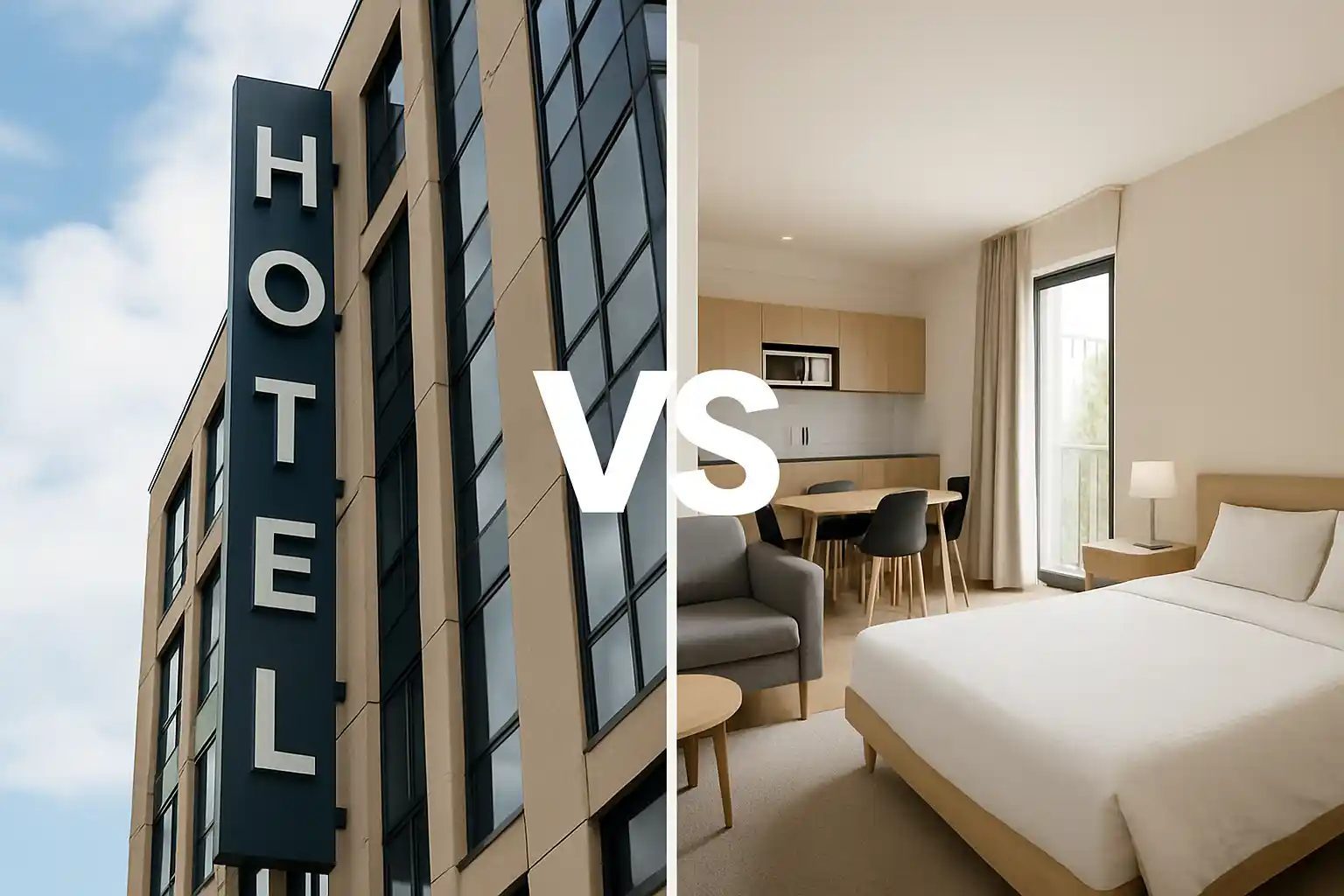
6. How to Run a Real Side-by-Side Comparison (With One Simple Formula)
Let’s turn this into a practical process you can reuse for any trip, whether you’re comparing the cost of Airbnb vs hotel for a week or just a quick weekend away.
Open three tabs: one Airbnb-style rental, one hotel, one hostel (if relevant). Then do this for each option:
- Get the true total
Go all the way to the final booking screen and write down the full price including every fee and tax. This is where the Airbnb cleaning fee impact, Airbnb service fee, and hotel resort fees vs Airbnb fees all show up. - Adjust for food
- If hotel breakfast is included, subtract a realistic daily value.
- If you’ll cook in a rental or hostel, estimate how many meals and subtract the savings vs eating out.
- Adjust for rooms/beds
If you’d need two hotel rooms but only one rental, compare the two-room hotel total to the one-unit rental total. Same for a private hostel dorm vs multiple hotel rooms. - Divide it down
Use this formula:Effective cost per person per night = (Total stay cost – value of included food) / nights / people
This is your true nightly rate calculation and the cleanest way to compare stay prices accurately. - Layer in non-monetary deal-breakers
Make a quick list of your non-negotiables: quiet, private bathroom, desk, late check-in, strong Wi‑Fi, no chores, etc. Cross out any option that fails your must-haves, even if it’s cheaper.
At this point, you’ll usually see a clear winner. If two options are within, say, 10–15% of each other, I stop obsessing and choose based on comfort and convenience, not the last few dollars.

7. Quick Decision Rules You Can Actually Use
If you don’t want to run a spreadsheet every time, use these blunt rules as a shortcut for your next Airbnb vs hotel cost comparison or hostel check.
Choose a hotel when:
- You’re staying 1–3 nights and need only one room.
- You care about predictability, security, and 24/7 support.
- You’re on a business trip or a tightly scheduled city break.
- The hotel includes breakfast and is centrally located.
Choose an Airbnb-style rental when:
- You’re staying 5–7+ nights.
- You’re a family or group that would otherwise need multiple hotel rooms.
- You’ll actually use the kitchen and extra space.
- You’re okay with a bit more uncertainty and self-management in exchange for space and a home-like feel.
Choose a hostel when:
- You’re on a tight budget and don’t mind shared spaces.
- You want a social atmosphere and don’t need luxury.
- You’re solo or with a small group and can grab a private dorm or room that undercuts hotels.
Underneath all of this is one simple mindset shift. Instead of asking, Is Airbnb cheaper than hotels?
or Are hostels always the budget option?
ask this:
For this exact trip, with this group size, in this city, on these dates, which option gives me the best value per person per night once I include all fees and food?
Run that calculation a few times and you’ll stop falling for misleading nightly rates — and start booking places that actually fit your budget and your style.