If you’ve ever thought Wow, this Airbnb is such a steal
and then watched the total double at checkout, you’re not alone. Hotels pull their own version of this with resort fees, parking, and taxes. The headline price is marketing. The real price is buried in the fine print.
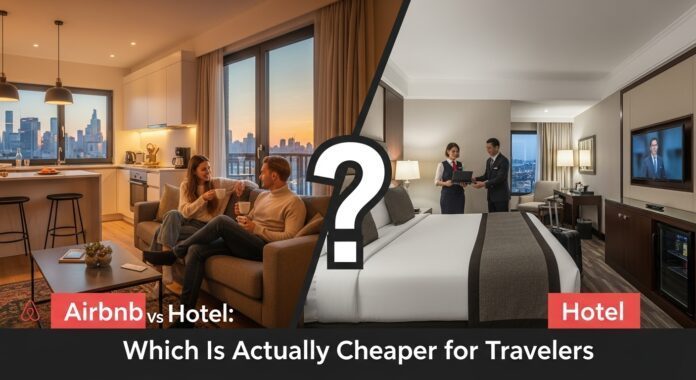
This guide walks through the hidden math of short-term rentals so you can do a real Airbnb vs hotel cost comparison. No loyalty to either side. Just numbers, trade-offs, and a simple way to see what’s actually cheaper for your trip.
1. Stop Comparing Nightly Rates: Build a Real Trip Total
The classic mistake? Seeing a $150 Airbnb next to a $190 hotel and assuming the Airbnb is the obvious win. That’s not how this works.
For any stay, you want to compare the total trip cost, not the nightly rate. That means looking at every line item, not just the big bold number at the top.
- Airbnb / vacation rental: nightly rate × nights + cleaning fee + Airbnb service fee + taxes + any extra guest or amenity fees
- Hotel: nightly rate × nights + taxes + resort fee + parking + any mandatory “destination” or “facility” fees
Research across U.S. markets shows that for short-term rentals, the final checkout total is often 45–70% higher than the advertised nightly subtotal once cleaning fees and taxes are added (source). Hotels usually have fewer line items, but resort and parking fees can still sting.
Here’s a simple way to compare the real price of Airbnb stays vs hotels:
- Open one Airbnb and one hotel you’d realistically book.
- Click through to the final price for your exact dates and group size.
- Write down the total for the stay (not per night).
- Divide by the number of nights to get a true per-night cost.
Only compare those final per-night numbers. Everything else is noise.

In one 3-night comparison across 28 U.S. markets, hotels were cheaper than whole-unit Airbnbs in 27 out of 28 markets for couples or solo travelers. That’s the opposite of what most people assume when they only look at the nightly rate.
2. The Cleaning Fee Trap: Why Short Stays Often Favor Hotels
Cleaning fees are where a lot of “cheap” Airbnbs quietly fall apart.
Think of the cleaning fee as a fixed cost. Whether you stay 1 night or 7, you pay it once. The fewer nights you stay, the more that fee inflates your effective nightly rate and distorts your Airbnb vs hotel cost comparison.
Example:
- Airbnb: $120/night × 2 nights = $240
- Cleaning fee: $120
- Service + taxes: say $60
- Total: $420 for 2 nights → $210/night real cost
Now compare a hotel:
- Hotel: $180/night × 2 nights = $360
- Taxes + fees: say $60
- Total: $420 for 2 nights → $210/night real cost
On paper, the Airbnb looked like $120 vs. $180. In reality, once you include short term rental hidden fees, they’re the same price. And in many cities, the hotel actually comes out cheaper for 1–3 night stays once you add everything up.
Data from multiple analyses shows:
- For 1–3 nights, hotels usually beat whole-unit Airbnbs on price for couples and solo travelers.
- For 3-night stays, Airbnbs often end up 30–80% more expensive than comparable hotels in urban and leisure markets.
If your trip is short and you’re not a big group, assume the hotel is the default winner until the math proves otherwise. This is one of the most common cost mistakes when booking Airbnb.
3. When Longer Stays Flip the Math in Favor of Airbnb
Now the twist: the same cleaning fee that kills short stays can make Airbnbs shine on longer ones.
Take that same $120 cleaning fee, but spread it over 7 nights instead of 2:
- Airbnb: $120/night × 7 nights = $840
- Cleaning fee: $120
- Service + taxes: say $140
- Total: $1,100 → about $157/night real cost
Now compare a mid-range hotel at $190/night for 7 nights:
- Hotel: $190/night × 7 nights = $1,330
- Taxes + resort/parking: say $210
- Total: $1,540 → about $220/night real cost
Suddenly the Airbnb is clearly cheaper per night. This is why many families and remote workers swear by longer stays and pay close attention to Airbnb weekly pricing vs hotel discounts.
Across real-world comparisons:
- For 5–7 nights or more, Airbnbs often become more economical, especially if you use the kitchen and laundry.
- One study of a 7-night U.S. family vacation found a typical 2-bedroom Airbnb around $1,400+ after fees, while two mid-range hotel rooms approached $2,900 before food.
So the rule of thumb:
- 1–3 nights: hotel usually wins (for 1 room).
- 4–6 nights: toss-up; run the numbers.
- 7+ nights: Airbnb often wins, especially for families or groups.

As stays get longer, the Airbnb per-night cost drops because fixed fees are spread out. Hotel pricing stays relatively flat, so the compare nightly rate to total stay cost exercise starts to favor short-term rentals.
4. Group Size: One Room vs Two Rooms vs Whole Place
Group size is where the decision really flips, especially for Airbnb vs hotel for family trips.
For solo travelers or couples who only need one room:
- Whole-unit Airbnbs are more expensive than hotels in the vast majority of U.S. cities for short stays.
- Private-room Airbnbs (where you share a home) are often cheaper than hotels, but you sacrifice privacy.
For families and groups who would need two or more hotel rooms, the math changes fast:
- Once you’d be paying for two hotel rooms, a 2–3 bedroom Airbnb often becomes cheaper in many markets.
- In one analysis, when a family needed two hotel rooms, whole-unit Airbnbs were cheaper in 19 of 28 markets.
Here’s a simple decision rule:
- If your group fits comfortably in one hotel room and you’re staying <= 3 nights → start with hotels.
- If you’d need two or more hotel rooms or you’re staying 5+ nights → start with Airbnbs and compare.
Also consider the non-math side:
- Airbnb: shared living room, kitchen, and often laundry. Better for late-night hangs, kids’ naps, and not tiptoeing around in one room.
- Hotel: separate rooms can mean more privacy for adults, but less shared space.

For families, that shared kitchen and living space can be worth a lot more than the raw nightly rate suggests. It’s a big part of the hotel vs vacation rental budget planning puzzle.
5. Food Math: The Hidden Budget Swing Most People Ignore
Accommodation is only half the story. Food can quietly blow up your budget or save you hundreds.
On a typical U.S. trip, a family of four eating all meals out can easily spend:
- $840–$1,400 per week on food alone.
Now add an Airbnb kitchen to the equation:
- Cook simple breakfasts and some lunches at “home”.
- Eat out mainly for dinners or special meals.
- Food costs drop to roughly $350–$700 per week.
That’s a potential savings of $490–$700 in one week. Suddenly, a slightly more expensive Airbnb can be cheaper overall than a hotel once you factor in food and the total trip cost Airbnb vs hotel.
On the flip side, many hotels include:
- Free breakfast (especially mid-range chains).
- Snacks or lounge access for elite members.
If breakfast for two would cost you $20–$30/day outside, a free hotel breakfast is effectively worth $140–$210 over a week.
Here’s how to compare honestly:
- Estimate how many meals you’d realistically cook in an Airbnb.
- Put a rough dollar value on those saved meals (even conservative numbers help).
- Subtract that from the Airbnb total cost.
- For hotels, add the value of free breakfast or lounge access if you’d actually use it.
Now you’re comparing total trip cost, not just beds.
Sometimes the hotel wins even after food math. Sometimes the Airbnb wins by a mile. The key is to actually run the numbers instead of guessing.
6. Fee Traps and Fine Print: Where Each Option Tries to Get You
Both Airbnbs and hotels have their own ways of hiding pain in the fine print. If you know where to look, you can dodge most of it.
Common Airbnb fee traps:
- Cleaning fees: can be as high as a full night or more, especially in popular destinations.
- Service fees: often around 14–20% of the subtotal.
- Extra guest fees: per-person charges beyond a base number of guests.
- Amenity/resort-style fees: for pools, gyms, parking, or “community” access.
- Local taxes and regulatory fees: added at checkout, not always obvious upfront.
- Security deposits and damage claims: more common than in hotels, adding risk and hassle.
- Early check-in/late checkout fees: often stricter and more expensive than hotels.
Understanding how Airbnb cleaning and service fees are explained in the breakdown is crucial if you want to avoid the worst short term rental fee traps.
Common hotel fee traps:
- Resort or destination fees: mandatory nightly charges for Wi-Fi, “amenities,” or nothing useful at all.
- Parking fees: especially in cities and resorts.
- Mini-bar and room service markups: easy to avoid if you’re disciplined.
- Taxes: usually shown near the end of the booking flow.
When you look at a hotel resort and parking fees breakdown next to an Airbnb quote, you start to see how similar the games really are.
How to protect yourself:
- Always click through to the final price before emotionally committing.
- On Airbnb, use filters to find low or no cleaning fee listings, especially for short stays.
- On hotel sites, look for “includes all taxes and fees” language and watch for resort fees in the breakdown.
- Read at least a few recent reviews for mentions of
extra fees
orsurprise charges
.
Once you know where each side hides the pain, it’s much harder for them to trick you.
7. Beyond Money: Predictability vs Space (What Do You Actually Value?)
Even when the prices are close, the experience is not. This is where you decide what you actually care about.
Hotels usually win on:
- Predictability: standardized rooms, clear policies, professional staff.
- Security & safety: regulated, with fire codes, cameras, and 24/7 front desk.
- Convenience: housekeeping, on-site restaurant/bar, gym, luggage storage.
- Support when things go wrong: you can walk downstairs and talk to someone.
Airbnbs usually win on:
- Space: separate bedrooms, living room, kitchen, sometimes outdoor areas.
- Home-like comfort: cook, do laundry, spread out, live more like a local.
- Neighborhood feel: residential areas instead of tourist or business districts.
- Long-stay comfort: better for remote work or slow travel.
But there are trade-offs:
- Airbnbs can come with house rules (no visitors, no shoes, quiet hours, chores before checkout).
- Quality is highly variable and depends on the host.
- Support when something breaks can be slow or awkward.
So ask yourself:
- Do I want to feel at home, or do I want to be taken care of?
- Is this trip about comfort and space, or simplicity and reliability?
- How much mental energy do I want to spend on check-in instructions, house rules, and messaging hosts?
There’s no universal right answer. There’s only what’s right for this specific trip.
8. A Simple Framework to Decide for Your Next Trip
Let’s pull this together into a quick framework you can reuse whenever you’re trying to calculate the real Airbnb cost and compare it to a hotel.
Step 1: Define your trip.
- How many people?
- How many nights?
- City, beach, mountain, or resort destination?
- Do you care more about space or convenience?
Step 2: Pick 2–3 realistic options on each side.
- 2–3 Airbnbs or short-term rentals you’d actually stay in.
- 2–3 hotels in similar locations and quality.
Step 3: Calculate real per-night cost.
- Click through to the final total for your dates and group size.
- Write down the total for the stay.
- Divide by nights → true per-night cost.
Step 4: Adjust for food and perks.
- Estimate savings from an Airbnb kitchen (even a rough number).
- Add the value of hotel free breakfast or loyalty perks if you’ll use them.
- Adjust your totals accordingly so you’re looking at total trip cost Airbnb vs hotel, not just room rates.
Step 5: Factor in your risk tolerance.
- If you hate uncertainty, late check-in drama, or variable quality → lean hotel.
- If you’re flexible and value space and a local feel → lean Airbnb.
In the end, don’t ask, Is Airbnb cheaper than hotels?
That question is too blunt.
Ask this instead:
For this specific trip, with this group size, this length of stay, and these priorities… which option gives me the best total value once I do the math?
Run the numbers once or twice and you’ll start to see patterns. After that, it gets a lot harder for either side to trick you with a pretty nightly rate and a pile of hidden fees at checkout.