

I used to think about flights in the simplest way possible: if I had miles, I’d use them. If the airline offered a voucher, I’d grab it. If the fare dropped, I assumed I’d get real money back.
Turns out, that’s not how this game works.
Once you start treating cash, airline credits, and points as three separate currencies with different rules and different risks, everything changes. You stop asking, Can I use miles?
and start asking, Is this actually a smart trade?
Think of this as a practical playbook you can run through before you hit Book or Accept Compensation. We’ll look at when to use airline credits, when cash wins, when points shine, and how to avoid the classic mistakes with airline travel credits and miles.
1. First Question: What Are Your Points Actually Worth?
Before you compare airline credits vs cash vs points, you need a baseline. I treat miles like a currency with a rough value in cents per mile (CPM). If I think my miles are worth 1.5 cents each, I don’t want to spend
them for 0.8 cents of value.
Here’s the simple math I use to price the value of airline miles compared to cash:
- Value per point/mile = (Cash price of ticket – taxes/fees you’d pay on an award) ÷ miles required
Example:
- Cash fare: $300
- Award: 20,000 miles + $11.20 in taxes
- Value per mile ≈ ($300 – $11.20) ÷ 20,000 = 1.44 cents per mile
If my personal target is 1.5–2.0 cents per mile, 1.44 CPM is borderline. I might still redeem if cash is tight, but I know I’m not redeeming airline miles for maximum value.
Sites like TPG’s monthly valuations or bank blogs (Chase, Amex, etc.) give decent benchmarks for how to price airline miles value, but I always adjust for my reality: how often I travel, how many miles I’m sitting on, and how easily I can earn more.
Takeaway: Set your own floor
value (for many people, ~1.3–1.5 cents per mile is reasonable). If a redemption falls below that, lean toward cash or airline credits instead of points.
2. Cheap Flight Coming Up: Cash, Points, or a Credit Burning a Hole?
This is the everyday scenario: you’re booking a relatively cheap flight and you have all three options on the table. Cash, points, and maybe a travel credit that’s quietly ticking toward expiration.
Here’s how I think through this flight payment strategy of cash vs points vs credits.
Step 1: Check the cash price vs points value
For cheap domestic or short-haul flights (say under $200–$250), cash usually wins in the cash vs points for flights debate. Why?
- Redemptions often give poor value (under ~1.2 CPM).
- You earn miles, elite credit, and credit card rewards on cash tickets.
As One Mile at a Time points out, you should also factor in what you earn on a paid ticket. If your card earns 5x points on airfare and you value those at ~1.7 cents each, that’s effectively ~8.5% back. Add the airline miles you earn and the real cost of the cash ticket is lower than the sticker price.
Step 2: Do you have an expiring airline credit?
This is where airline credits vs cash gets interesting. If you have a credit that expires in a few months, I treat it as use it or lose it
money. In that case:
- Use the credit first on cheap flights, even if the cents-per-mile math would favor saving points.
- Save your flexible points and cash for trips where they can stretch further.
Using expiring airline credits on flights you’d book anyway is almost always the best use of airline travel credits. Letting them die in your account is one of the most common mistakes with airline travel credits.
Step 3: Are you chasing elite status?
If you care about elite status, cheap flights are perfect mileage runs. Award tickets often don’t earn elite-qualifying credit, while cash tickets do. Airline credits usually count as paid tickets too, so they help here.
That tilts the scale toward cash or credits instead of points.
My rule of thumb for cheap flights:
- Use cash if the fare is low and you’re getting under ~1.3–1.5 CPM from points.
- Use airline credits if they’re expiring soon or you have more credit than you can realistically use later.
- Use points only if cash is tight or the redemption value is surprisingly high for such a cheap ticket.

3. Big Trip or Premium Cabin: When Points Beat Everything
Now flip the script. You’re looking at an expensive international trip or a premium cabin. This is where the value of airline miles compared to cash can swing hard in favor of points.
Typical sweet spots where points vs cash for international flights gets interesting:
- Long-haul business or first class (to Europe, Asia, etc.)
- Peak holiday travel when cash prices surge
- Last-minute flights where cash is sky-high but award prices haven’t moved much
- One-way international tickets, which are often disproportionately expensive in cash
On these, it’s not unusual to see 4–10+ cents per mile, especially with good partner awards. That’s far beyond what you’ll get on most economy tickets and often makes points the clear winner in the airline credits vs points vs cash comparison.
But there are two traps I watch for.
Trap 1: High surcharges and fees
Some airlines add big fuel surcharges on award tickets. If you’re paying $800 in fees plus a pile of miles, your CPM can drop fast. I always plug the numbers into the same formula and check if the value still clears my personal bar.
Trap 2: Overpaying in points just because you can
Dynamic pricing means some programs now want 300,000+ miles for a one-way business-class ticket. At that point, I ask:
- Is there a partner airline with a better award chart?
- Could I pay cash (or use credits) and save points for a better deal later?
As Upgraded Points notes, small differences in miles (52k vs 60k) matter less than the overall experience: lie-flat seat, privacy, lounge access, etc. I’m willing to pay a bit more in miles for a much better product, but not double.
My rule of thumb for big trips:
- Use points when you’re getting clearly above your target CPM (often 2+ cents) and especially for premium cabins.
- Use cash or credits when award prices are inflated or fees are ridiculous.
- Save flexible bank points (Amex, Chase, etc.) for these high-value redemptions, not for cheap domestic hops.
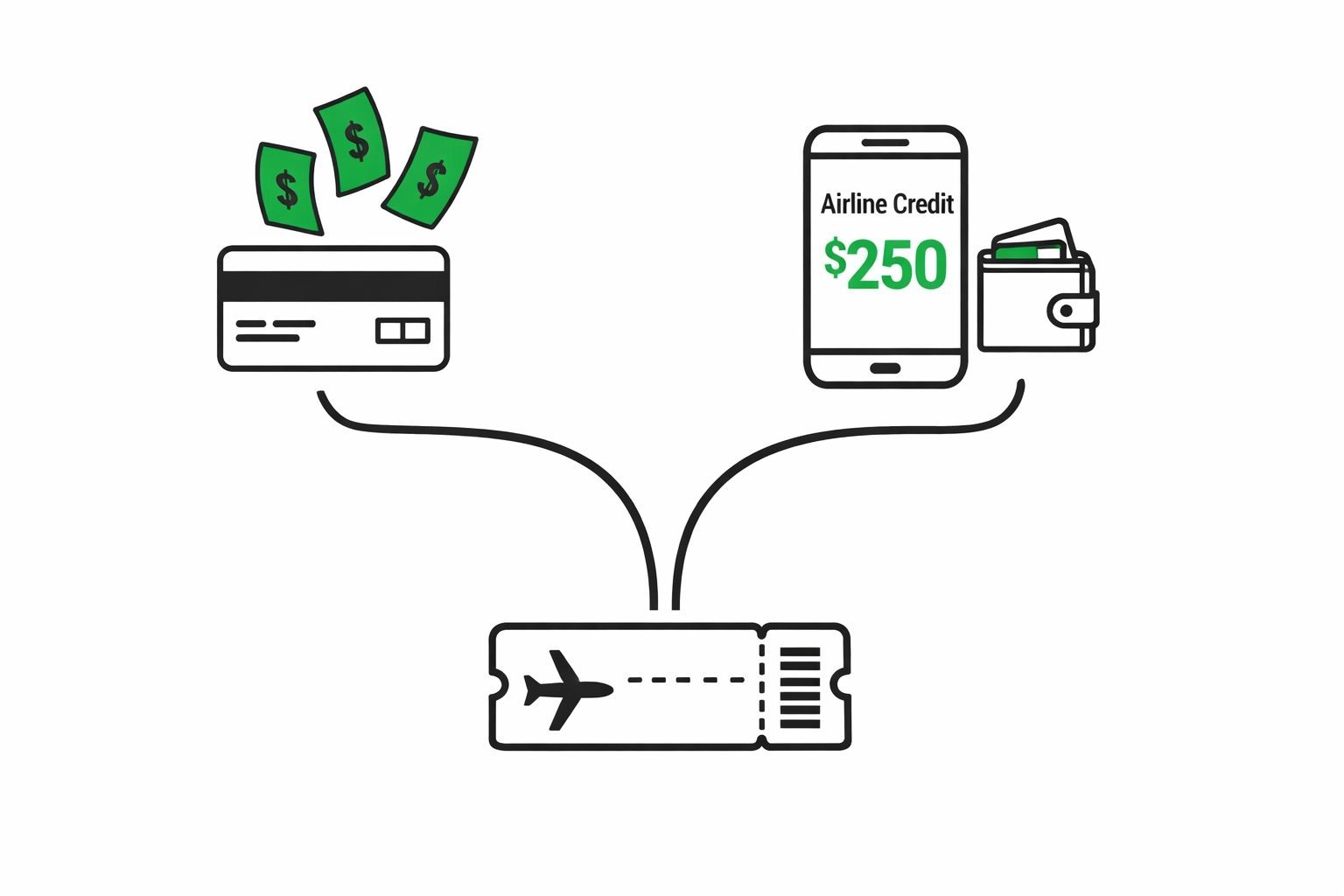
4. Airline Credits vs Cash Refunds: What You Really Get When Prices Drop
Here’s a scenario that trips people up all the time: your flight price drops after you book. Are you getting a refund, a voucher, or just a credit locked to that airline?
In most cases, for nonrefundable tickets, you’re getting an airline credit, not cash. That’s a big difference in the airline voucher vs refund decision.
- Cash refund: goes back to your card, fully flexible, can be spent on anything.
- Airline credit: locked to that airline, usually expires in about 12 months, and may have usage rules.
According to Refare, true cash refunds are mostly limited to:
- Refundable fares
- Changes/cancellations within 24 hours of booking (for eligible itineraries)
After that window, most airlines will give you a credit if the fare drops or you change plans. That credit might live in:
- A
travel wallet
on your profile - Your frequent flyer account
- A voucher code you need to keep track of
Some tools and services can even route savings into your loyalty account, letting you keep your miles and status while also getting value back — a kind of loyalty double-dip
.
How I decide between cash and credits when I have a choice:
- If I can get a cash refund back to my card, I almost always take it. Cash is king.
- If the airline only offers a credit, I ask:
Am I realistically going to fly this airline again before it expires?
If not, I push harder for cash or rethink the change.
Understanding airline credit expiration rules is key here. A generous-looking credit that expires in 6 months and can only be used by the original traveler is very different from a flexible voucher with a long life.
5. Disrupted Flight: Should You Take Cash, Miles, or a Voucher?
When things go sideways — delays, cancellations, overbooking — airlines may offer you compensation. This is where emotions run hot and people make fast choices they regret later.
I try to pause and ask three questions.
1. What am I legally entitled to?
Under the 2024 U.S. DOT refund rule, if your flight is canceled or significantly delayed and you choose not to travel, you’re entitled to a refund, not just a credit. On some U.S.–Europe routes, EU261 can entitle you to substantial cash compensation for delays or being bumped — sometimes up to around $700.
That’s real money. I don’t trade that away lightly for a voucher or a handful of miles.
2. What form of compensation is most useful to me right now?
- Cash: most flexible, safest choice, especially if the amount is large or you’re not a frequent flyer.
- Miles/points: can be more valuable than cash if you know how to use them and travel often.
- Vouchers/credits: useful only if you’re sure you’ll fly that airline again before expiry and the amount is generous.
As Upgraded Points notes, cash is usually the safest default. But if an airline offers, say, $200 cash or 25,000 miles and you know you can get 1.5–2.0 CPM from those miles, the miles might be worth more to you than the cash.
3. Can I politely negotiate?
Airlines aren’t obligated to give you more than the rules require, but it’s often worth asking:
- If they offer a voucher, ask if they can do cash instead.
- If they offer miles, ask if they can increase the amount or add a travel credit.
My rule of thumb for disruptions:
- Take cash when the amount is meaningful or you’re not sure about future travel.
- Consider miles if you’re a frequent traveler and can clearly beat the cash value with smart redemptions.
- Accept vouchers only if you’re confident you’ll use them and the terms (expiry, restrictions) are reasonable.

6. Uncertain Plans: Flexibility vs Value
Sometimes the main question isn’t What’s the best value?
but How likely am I to change or cancel this trip?
In that situation, points and miles can quietly shine, even if the raw cost comparison of cash vs points for flights doesn’t look amazing on paper.
Many U.S. airlines now offer:
- More flexible changes on award tickets — often with miles redeposited and only taxes refunded or a small fee.
- Less flexibility on cash tickets — you usually end up with a credit, not a refund, unless it’s a refundable fare.
So even if the cents-per-mile value isn’t spectacular, I sometimes use points when my plans are shaky. I’m effectively paying a small premium in value for better flexibility and lower risk.
On the flip side, if my plans are rock solid and the cash fare is good, I’m more comfortable paying cash (or using credits) and saving points for a future, more uncertain trip.
My rule of thumb for uncertain plans:
- Use points when flexibility and easy cancellations matter more than squeezing every last cent of value.
- Use cash or credits when your dates are firm and the fare is attractive.
7. Putting It All Together: A Simple Playbook You Can Reuse
When I’m staring at a booking screen, trying to decide between airline credits vs cash vs points for that specific flight, I run through a quick mental checklist.
- What’s my target value per mile?
If the redemption is below my floor (say 1.3–1.5 CPM), I lean toward cash or credits. - Is this a cheap flight or an expensive one?
Cheap: usually cash/credits. Expensive or premium cabin: usually points, if the value is strong. - Do I have expiring airline credits?
If yes, I prioritize using them on flights I’d book anyway. That’s the best use of airline travel credits. - Am I chasing elite status?
If yes, I favor cash/credits because they earn elite credit; awards often don’t. - How uncertain are my plans?
High uncertainty: points for flexibility. Low uncertainty: cash/credits for value. - In a disruption, what am I legally owed?
If I’m entitled to cash, I think very hard before trading it for miles or vouchers.
If you start treating cash, credits, and points as three different tools — not interchangeable free stuff
— your decisions get sharper. You’ll say no
to bad redemptions, stop letting credits expire, and save your best points for the trips where they really move the needle.
Next time you book, don’t just ask, Can I use miles?
Ask, What’s the smartest currency to spend on this flight?
That one question alone can save you a surprising amount over a few years of travel.