
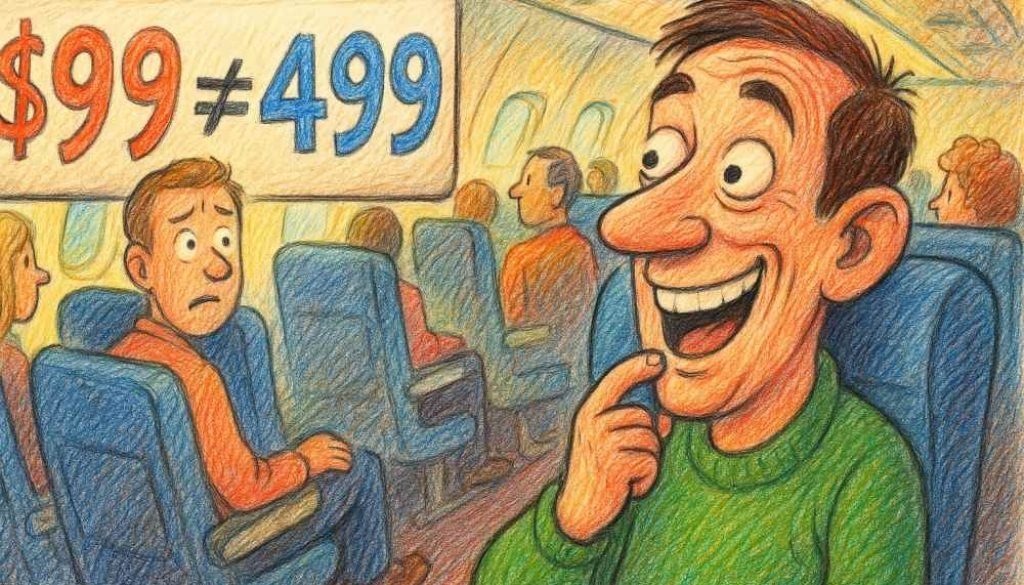
I’ve sat down on a flight, opened my email, and immediately regretted it.
Two rows behind me, someone is bragging about the “steal” they got on this exact flight. Same route. Same cabin. Sometimes even the same row. Yet I paid more.
If you’ve had that moment, this guide is for you.
Airlines aren’t guessing. They’re running one of the most sophisticated pricing games on earth. Once you understand that game – especially fare buckets and economy fare class pricing – you can stop feeling ripped off and start using the system to your advantage.
1. The uncomfortable truth: you’re not buying a seat, you’re buying a bucket
On paper, you and your seatmate both bought “economy.” In reality, you bought different products that just happen to look the same once you’re on board.
Behind every economy ticket is a hidden code – a single letter like Y, M, K, Q, L, T. That letter is your fare bucket (also called booking class or fare class code). It decides:
- How much you paid
- How painful changes and cancellations are
- How many miles or points you earn
- Whether you’re even eligible for an upgrade
Same cramped seat, totally different rules.
Airlines slice the cabin into price layers
. A typical flight can have 10+ different economy prices alone. At the bottom: a few ultra-cheap, heavily restricted seats. Above that: a stack of slightly more expensive, slightly more flexible fares. At the top: fully flexible economy that can cost more than premium economy or even business when those cabins are on sale.
Here’s the mindset shift that makes airline fare buckets click:
You’re not asking “what does this seat cost?” – you’re asking “which bucket is still open when I book?”
Once the cheapest buckets sell out or are closed by the airline’s system, you’re pushed into the next one up. That’s why your seatmate paid less: they grabbed a cheaper bucket before it disappeared.
2. How airlines decide your price: yield management in plain language
Airlines treat seats like a perishable product. Once the plane door closes, an empty seat is worth exactly zero. So they use yield management and dynamic pricing to squeeze as much money as possible out of every seat before that door shuts.
Here’s the simplified version of what’s happening in the background when you see those wild economy ticket price swings:
- Software watches bookings in real time: how fast seats are selling, which days, which routes.
- It compares that to forecasts: holidays, big events, school breaks, historical data.
- It opens or closes fare buckets: cheap buckets close as demand rises; if a flight is weak, some cheaper buckets may quietly reopen.
- It nudges prices constantly: sometimes every few minutes across different sites and countries.
So when you see a fare jump $40 in an hour, it’s usually not “the last seat just sold.” It’s the system deciding, We can probably get more for the remaining seats.
What this means for you:
- Prices trending up is normal as departure approaches, especially in the last 7–14 days.
- Short dips can appear when the system overestimates demand and reopens cheaper buckets.
- Two people searching the same flight can see different prices if they hit different moments in that adjustment cycle.
If you’ve ever watched a fare bounce up and down over a few days, you’ve seen airline dynamic pricing in action.
3. Timing your purchase: when cheaper buckets are actually available
Now to the part you can actually control: when you buy.
Airlines design their pricing around two broad groups:
- Price-sensitive travelers (you, most of the time): book earlier, flexible on dates, hunt for deals.
- Time-sensitive travelers (business, emergencies): book late, less flexible, will pay more.
So the system rewards one behavior and punishes the other:
- Book early: more cheap buckets are open. You’re competing with other planners, not last-minute business travelers.
- Book late: most cheap buckets are gone or closed. You’re paying for the privilege of having no flexibility.
Typical patterns (not hard rules, but useful guardrails for when to book economy flights cheaper):
- Domestic flights: often best 1–3 months out.
- International flights: often best 2–6 months out.
- Peak periods (Christmas, summer, big events): earlier is almost always better; cheap buckets vanish fast.
There’s also a weekly rhythm:
- Midweek departures (Tue/Wed, sometimes Sat) tend to have more cheap buckets.
- Friday evenings and Sunday afternoons are prime business and weekend travel – expect higher buckets only.
My personal rule: if I see a fare that’s clearly below the usual range for that route and date, I don’t wait for perfection. Good and bookable beats theoretical and gone.
4. Why your search behavior can quietly push you into a higher bucket
This is the part that makes people suspicious – and honestly, they’re not entirely wrong.
Some airlines and booking sites use your behavior as a signal:
- Repeated searches on the same route and dates
- Logged-in frequent flyer profiles
- Device type, location, even currency
They’re trying to answer one question: How badly do you want this flight?
If you keep checking the same itinerary, the system may infer urgency and:
- Stop showing the very cheapest buckets
- Show you fewer options than a “fresh” user sees
- Round prices up rather than down
Is this always happening? No. Is it happening sometimes? Yes. There are documented cases where the same airline showed different prices on its app vs. website, or to logged-in vs. anonymous users.
Practical ways to avoid being nudged into a higher bucket and accidentally overpaying for plane tickets:
- Search in a “clean” environment: incognito window, different browser, or even a different device when you’re ready to buy.
- Compare channels: airline website vs. app vs. a major OTA (online travel agency). Sometimes one still has a cheaper bucket open.
- Test currencies and locations: on some routes, changing your point-of-sale (via country site or VPN) can surface different prices.
One more thing: don’t obsess over every $5 fluctuation. Focus on avoiding the big jumps that come from being pushed into a completely different fare bucket.
5. Flexibility: the single biggest lever you have over fare buckets
If you want the cheaper economy ticket, you need to think like the system. It rewards people who are flexible on three axes:
- Date
- Time of day
- Routing
Here’s how each one opens up cheaper buckets and improves your economy ticket price comparison.
Dates: move your trip, move your price
- Use flexible date search (calendar or “+/- 3 days” tools) to see where the cheap buckets live.
- Look for midweek departures domestically and Mon–Thu for many international routes.
- Avoid obvious peaks: school holidays, long weekends, major events at your destination.
Times: fly when others don’t want to
- Early morning, midday, and red-eye flights often have more low buckets open.
- Those “inconvenient” times are exactly where the system discounts to fill seats.
Routing: trade convenience for price
- Nonstops are premium products; airlines protect higher buckets on them.
- One-stop or two-stop itineraries often dip into cheaper buckets, especially on competitive routes.
- Sometimes flying from or to a nearby airport (within a few hours’ drive) unlocks much lower fare classes.
If you’re serious about saving, try this exercise: pick your route, then ask yourself, What can I flex: dates, times, airports, or all three?
The more you can move, the more likely you are to land in the lowest bucket that still exists.
6. Reading between the lines: what your fare bucket actually buys you
Most people stop at the price. That’s a mistake. Two economy fares that differ by $40 can have very different rules.
When you click into the fare details, look for:
- Change fees: Is it changeable at all? Is there a fee plus fare difference?
- Refundability: Nonrefundable, partially refundable, or fully refundable?
- Minimum stay / Saturday night: Common on international routes for the lowest buckets.
- Seat selection and baggage: Some “basic” buckets exclude both.
- Mileage earning and status credits: Deep-discount buckets may earn reduced miles or none at all.
Here’s the twist: sometimes the cheapest-looking economy fare is actually bad value for how you travel.
Examples I’ve seen more than once:
- A rock-bottom economy fare that becomes expensive once you add a checked bag and seat selection.
- A slightly higher economy fare that earns full miles and is changeable – worth it if your plans might move.
- A sale in premium economy or business that’s cheaper than fully flexible economy on the same flight.
So before you click “buy,” ask:
Am I choosing the lowest price, or the best value bucket for how I actually travel?
7. Concrete strategies to land the cheaper economy ticket
Let’s pull this together into a practical playbook you can actually use to avoid mistakes that raise flight cost.
Step 1: Learn the “normal” price for your route
- Use fare calendars and historical tools to see typical ranges.
- Set price alerts a few months out for international, a couple of months for domestic.
- When you see a fare clearly below the usual range, that’s your cue: a lower bucket is open.
Step 2: Search smart, not obsessively
- Do your exploratory searches in one browser; do your final booking in another or in incognito.
- Compare airline site vs. app vs. one or two major OTAs. Don’t assume they’re identical.
- Check the final price with all taxes and fees before deciding which channel to use.
Step 3: Flex what you can
- Use “flexible dates” to find cheaper days.
- Try different departure times on the same day.
- Test nearby airports and one-stop options if the nonstop is expensive.
Step 4: Decide your risk tolerance
- If the price is good and the flight is important (holiday, wedding, limited dates), book when you’re comfortable. Waiting for a miracle bucket can backfire.
- If your dates are flexible and the trip is optional, you can afford to watch for a few days to see if a lower bucket reopens.
- On some airlines, consider a paid fare hold if you need 24–72 hours to decide and the price looks unusually low.
Step 5: After booking, stop checking (mostly)
- For nonrefundable tickets, constant re-checking just fuels regret.
- For flexible or changeable tickets, an occasional check can pay off if the fare drops and your airline allows repricing.
The goal isn’t to win every time. It’s to avoid consistently overpaying because you didn’t understand how airlines price economy seats.
8. The mindset shift that actually saves you money
Once you see how fare buckets work, the price differences on your flight stop feeling random or personal. They’re not. They’re the result of a system designed to charge each of us as close as possible to our maximum willingness to pay.
You don’t have to like that system. I don’t. But you can use it.
Here’s the mindset I try to keep:
- Assume almost no one on your flight paid the same price you did.
- Focus on your own trade-offs: flexibility vs. price, convenience vs. savings.
- Use the tools: alerts, flexible dates, multiple channels, and a bit of timing.
Next time you board and hear someone brag about their bargain, don’t spiral. Ask yourself a better question:
Given my dates, my flexibility, and my risk tolerance, did I land in a reasonable bucket?
If the answer is yes, you’re already ahead of most people on that plane.