
I’ve lost count of how many times I’ve stared at two tabs on my screen:
- Direct flight: fast, simple, usually pricey.
- Connecting flight: cheaper, longer, a bit of a gamble.
If you’ve ever wondered, Am I really saving money, or just paying in exhaustion instead of cash?
you’re not alone.
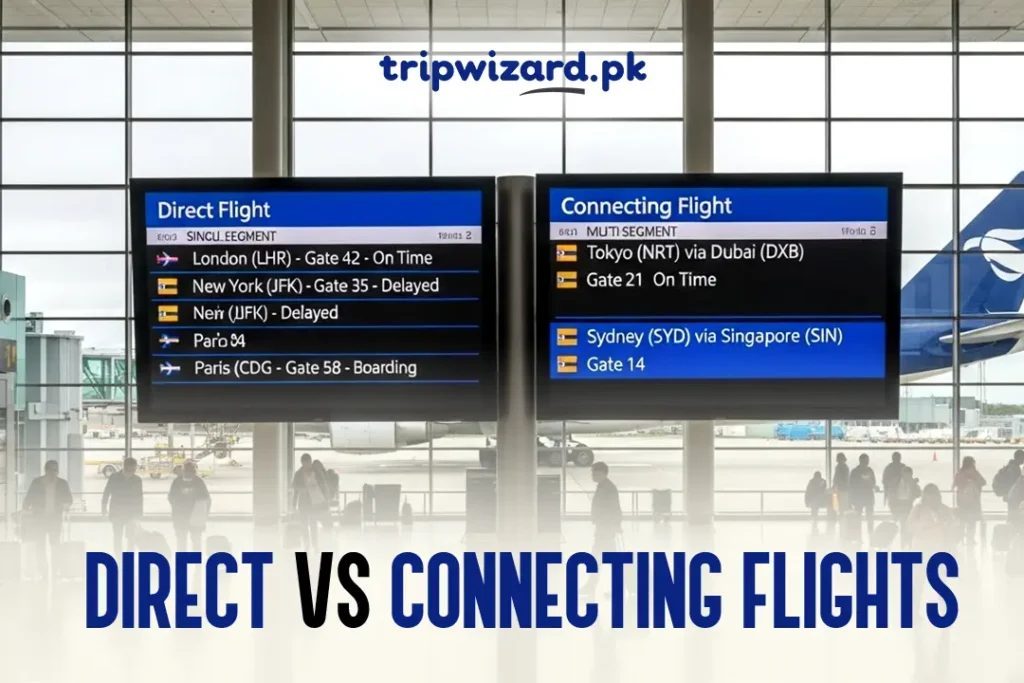
Let’s unpack the real trade-off between time and cost, and look at how direct vs connecting flights actually work in practice—not just in airline ads.
1. First Decision: Do You Really Understand the Flight Types?
Before you compare prices, you need to know what you’re actually booking. Airlines don’t always make this clear, and the wording can be misleading.
Here’s the simple breakdown:
- Non-stop flight: One takeoff, one landing, no stops in between. Fastest option and usually the most expensive. (source)
- Direct flight: Same flight number the whole way, but there may be a stop. You might stay on the plane, or sit through boarding again.
- Connecting flight: You change planes. At least one layover, sometimes more.
Most people say direct
when they really mean non-stop
. That mix-up can cost you both time and money, especially on international routes where the difference matters.
How I use this in real life:
- If I care about sleep, tight schedules, or traveling with kids: I filter for non-stop only.
- If I care more about price: I allow 1 stop, then compare total journey time against the savings.

Takeaway: Always check whether your so-called direct
flight is actually non-stop. A sneaky fuel stop or short halt can add 1–2 hours for zero real benefit.
2. Time vs Money: What Is Your Hour Actually Worth?
This is the heart of the direct vs connecting flights debate: How much is one hour of your time worth on this specific trip?
Say you’re choosing between:
- Non-stop: 7 hours, $650
- Connecting: 11 hours, $480
You save $170 but add 4 hours of travel. That works out to about $42.50 per extra hour.
Now ask yourself:
- Would you trade 4 hours of your time, energy, and comfort for $170?
- Is this a quick weekend trip where losing half a day kills the vibe?
- Or a long holiday where a few extra hours in transit doesn’t really matter?
In 2024, the price gap between direct and connecting flights has actually shrunk on many routes to around 5–10% (source). That changes the math:
- If the saving is tiny (say $40 on a $600 ticket), I usually pay for the faster, non-stop option.
- If the saving is big (20–40%), I start asking:
What’s the catch?
Quick rule I use:
- If I’m saving less than $25 per extra hour of travel, I usually go direct/non-stop.
- If I’m saving more than $50 per extra hour, I seriously consider the layover.
Takeaway: Don’t just compare ticket prices. Compare dollars saved per extra hour and decide if that trade feels fair for this trip.
3. Risk & Stress: How Much Uncertainty Can You Tolerate?
Every connection you add is another roll of the dice. That’s where a lot of the hidden cost of connecting flights lives.
With a non-stop flight:
- No connections to miss.
- Lower chance of lost baggage.
- Less mental load: one gate, one boarding, one arrival.
With connecting flights:
- More chances for delays to snowball.
- Higher risk of missed connections and missed connection flight problems.
- More walking, more security checks, more gate changes.
Airlines know this. That’s why connecting flights are often cheaper: you’re being paid, in a way, to take on more risk and more hassle.
Some airports are smooth for connections. Others are chaos. Minimum Connection Time (MCT) matters a lot here (source), especially when you compare direct and connecting flights on busy international routes.
How I personally handle risk:
- If I have an important event (wedding, exam, big meeting): I avoid connections or fly in a full day early.
- If I must connect, I aim for at least 90–120 minutes on international routes.
- I avoid separate tickets unless the savings are huge and I can build in a long buffer.

Takeaway: If a missed connection would be a disaster, the cheap
ticket can easily become the most expensive choice you make.
4. Comfort, Fatigue & Health: Will You Arrive Human or Wrecked?
On paper, a 4-hour layover doesn’t look too bad. In real life, it can feel like an endless loop of bad chairs, dry air, and overpriced coffee.
Direct and non-stop flights usually mean:
- Less total time in transit.
- Fewer takeoffs and landings (often the most tiring parts).
- A better chance of real sleep on overnight routes.
Connecting flights often mean:
- More fatigue, especially if you’re already short on sleep.
- Extra effort if you’re traveling with kids, elderly relatives, or anyone with mobility issues.
- Frustration if the layover airport has poor seating, limited food, or no decent lounge.
That said, some travelers actually prefer a break on ultra-long-haul routes. A 16-hour non-stop can be brutal. Splitting it into 7 + 8 hours with a decent airport in between can feel more manageable.
In 2024, ultra-long-haul non-stops (16+ hours) have become more efficient and sometimes even cheaper than multi-stop options (source). But cheaper doesn’t always mean easier on your body.

Ask yourself:
- Do I need to be functional within a few hours of landing?
- Am I traveling with someone who doesn’t handle long days well?
- Is there a decent lounge, quiet area, or at least comfortable seating at the layover airport?
Takeaway: If arriving exhausted wipes out the first 1–2 days of your trip, that’s a hidden cost. Sometimes paying more for a direct flight is really paying for an extra day of feeling human.
5. Visas, Baggage & Hidden Hassles: The Fine Print That Bites
This is where a lot of people get caught. The connecting ticket looks cheap. The reality, once you add everything up, isn’t.
Transit visas:
- Some countries require a transit visa even if you never leave the airport.
- Rules vary by nationality, airline, and route (source).
- Direct or true non-stop flights avoid this completely.
Baggage:
- If all legs are on one ticket, your checked bag usually goes straight to your final destination.
- If you book separate tickets to save money, you may need to:
- Collect your bag at the layover airport.
- Clear immigration and customs.
- Re-check your bag and go through security again.
- Every extra step is another chance for your bag to go missing or for you to miss the next flight.
Hidden costs during layovers:
- Airport food and drinks (which add up fast).
- Lounge access, showers, or day rooms if you want to rest.
- Transport, visas, and meals if you leave the airport on a long layover.
Once you add these, the cheap
connecting ticket can creep surprisingly close to the price of a direct flight (source), especially on international direct flight vs connection routes.
Takeaway: Always factor in visas, baggage handling, and layover spending. If the savings disappear once you add those, the direct option wins.
6. When a Stopover Is Actually a Smart Upgrade, Not a Downgrade
Not every connection is a necessary evil. Sometimes, a stopover is the best part of the trip.
Many airlines and hubs quietly reward you for being flexible with your route:
- Less popular multi-leg routes are often heavily discounted to fill seats (source).
- Some hubs offer free hotel nights, city tours, or meal vouchers on long layovers.
- You can turn a layover into a mini side-trip without buying separate flights.
For example:
- Flying to Europe via Istanbul or Doha and spending a few hours exploring.
- Reaching the US via a Canadian or European hub and squeezing in a quick city visit.
If you’re not in a rush, a 10–20 hour layover can become:
- A short city walk and a good meal.
- A proper sleep in a hotel instead of trying to nap upright.
- A chance to see an extra country for almost no extra flight cost.
When I actively choose a stopover:
- On long-haul leisure trips where I want to break the journey.
- When the stopover city is somewhere I actually want to visit.
- When the airline or hub offers real perks (hotel, meals, tours) that offset the extra time.
Takeaway: If you’re flexible, a well-planned stopover can turn extra travel time
into extra destination
—and still save you money compared with a non-stop.
7. A Simple Framework: How to Decide in Under 5 Minutes
Here’s the quick process I use when I’m stuck between a direct flight and a cheaper connection.
- Check the basics:
- Is the
direct
flight actually non-stop? - What’s the total journey time for each option, door to door?
- Is the
- Calculate your trade-off:
- How many extra hours does the connecting option add?
- How much money do you save?
- Money saved ÷ extra hours = value of each extra hour.
- Stress-test the itinerary:
- Is there at least 90–120 minutes for international connections?
- Is everything on one ticket, or are you juggling risky separate bookings?
- How bad is it if you arrive late, or completely wiped out?
- Check hidden friction:
- Do you need a transit visa for the layover country?
- Is the layover airport decent, or a guaranteed headache?
- What extra costs will you have (food, hotel, lounge, transport)?
- Match to your trip type:
- Business, medical, or short trips: usually worth paying for direct/non-stop.
- Long holidays or flexible schedules: connections and stopovers can be a smart way of saving money with layover flights.
- Travel with kids, elderly relatives, or lots of baggage: fewer connections usually means fewer headaches.

Final thought: There’s no universal answer to Are direct flights worth it?
But there is a right answer for this trip, with your budget, your energy level, and your tolerance for chaos.
Next time you’re tempted by a cheaper connecting flight, don’t just ask, How much does it cost?
Ask, What am I really paying with—money, or time, or sanity?