
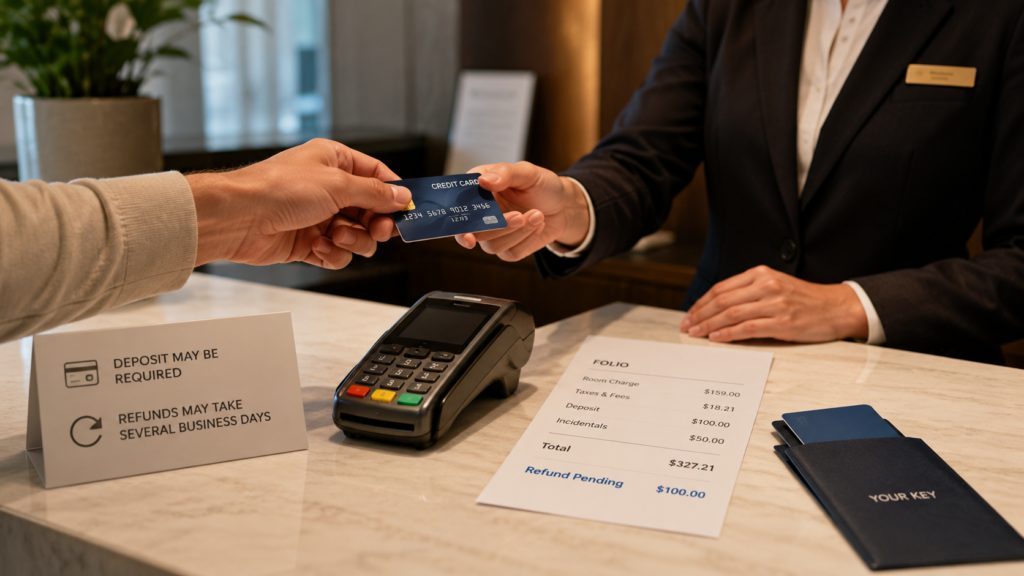
I don’t usually lose money when I travel. I lose access to my money.
It’s the hotel “deposit” that isn’t really a deposit. The card hold that lingers for 10 days. The refund your bank swears is “on the way.” None of this shows up in glossy destination photos, but it can wreck a carefully planned trip faster than a flight cancellation.
This is the quiet travel cash flow trap most people don’t see coming. In this guide, I’ll walk through how holds, deposits, and refund timelines actually work, how they quietly strangle your budget, and what I now do before every trip to avoid getting stuck with a “card declined” message in the middle of a trip.
1. The Language Trap: When “Deposit” Doesn’t Mean What You Think
When a hotel says, We just need a deposit,
what do you picture?
- You’ll pay now and get that exact amount back later?
- It’s a damage deposit only?
- It’s just a temporary hold?
All three can be wrong. The word “deposit” gets used for several totally different money moves, and each one hits your travel budget in a different way. Based on how hotels describe it, you often can’t tell which one you’re agreeing to—and that’s where the cash flow problems from delayed travel refunds and holds begin.
Here’s how I break it down now:
- Booking deposit – Paid before arrival to secure the reservation. It’s usually applied to your final bill, not refunded as a separate transaction. You don’t “get it back”; you just pay less at checkout. Confusing this with a refund is one of the classic hidden costs of refundable travel bookings.
- Security/damage deposit – A refundable amount held in case of damage, smoking, missing items, or unpaid charges. You should get this back after checkout if nothing goes wrong, but the timing can be fuzzy.
- Incidental hold – A temporary pre-authorization at check-in to cover extras like minibar, parking, or room service. It reduces your available credit but may never post as a real charge.
- Prepaid / non-refundable rate – You pay in advance, sometimes in full. If you cancel late or no-show, the hotel can keep some or all of it. This is where the prepaid vs pay at hotel comparison really matters.
The cash-flow problem? On your card, these all look similar at first. A “pending” amount, a strange line item, a lower available balance. If you don’t know which type you’re dealing with, you can’t predict when that money becomes usable again—and that’s how a simple weekend away turns into a travel cash flow trap.
Before I confirm any booking now, I ask the front desk or booking agent four very specific questions:
- Is this a charge or a temporary hold?
- Will this be applied to my final bill, refunded, or just released?
- Under what conditions do you keep any part of it?
- How long after checkout until the hold is released or the refund is processed?
If they can’t answer clearly, I assume my cash flow is at risk and either switch properties or adjust my budget on the spot.

2. Holds vs. Charges: The Invisible Squeeze on Your Credit Limit
Most hotels don’t actually charge your card for incidentals at check-in. They place a pre-authorization hold. That sounds harmless. It isn’t.
A hold is not money taken from your account, but it locks up part of your credit limit or bank balance until it’s released. You don’t see a final charge, but your available credit shrinks. This is where credit card holds for travel bookings quietly squeeze your spending power.
Typical pattern:
- Room + taxes for your stay are authorized.
- Plus a daily buffer (often $50–$200 per night) for incidentals.
- At checkout, the hotel converts part of that hold into a real charge and releases the rest.
On a 5-night stay at $180/night, a hotel might hold:
- $900 for room + tax
- +$75/night for incidentals = $375
- Total hold: $1,275
If your card limit is $2,000 and you arrived with a $500 balance already on it, you’ve just lost almost all your usable credit for the week. You haven’t done anything wrong. You just didn’t see the hold coming.
With debit cards, it’s worse. That hold can tie up actual cash in your bank account, not just credit. You might have $1,500 in the bank and suddenly only $200 is spendable until the hold drops off. That’s a nasty surprise when you’re trying to pay for food or a train ticket.
My rule now:
- Use a credit card for hotels whenever possible.
- Keep a separate card with a clean limit just for travel holds and deposits.
- Before check-in, ask:
What total amount will you pre-authorize, including incidentals?
Once you know the number, you can decide if that card can handle it or if you need to switch cards on the spot. That’s the heart of travel budgeting around card holds: know the hit before it lands.
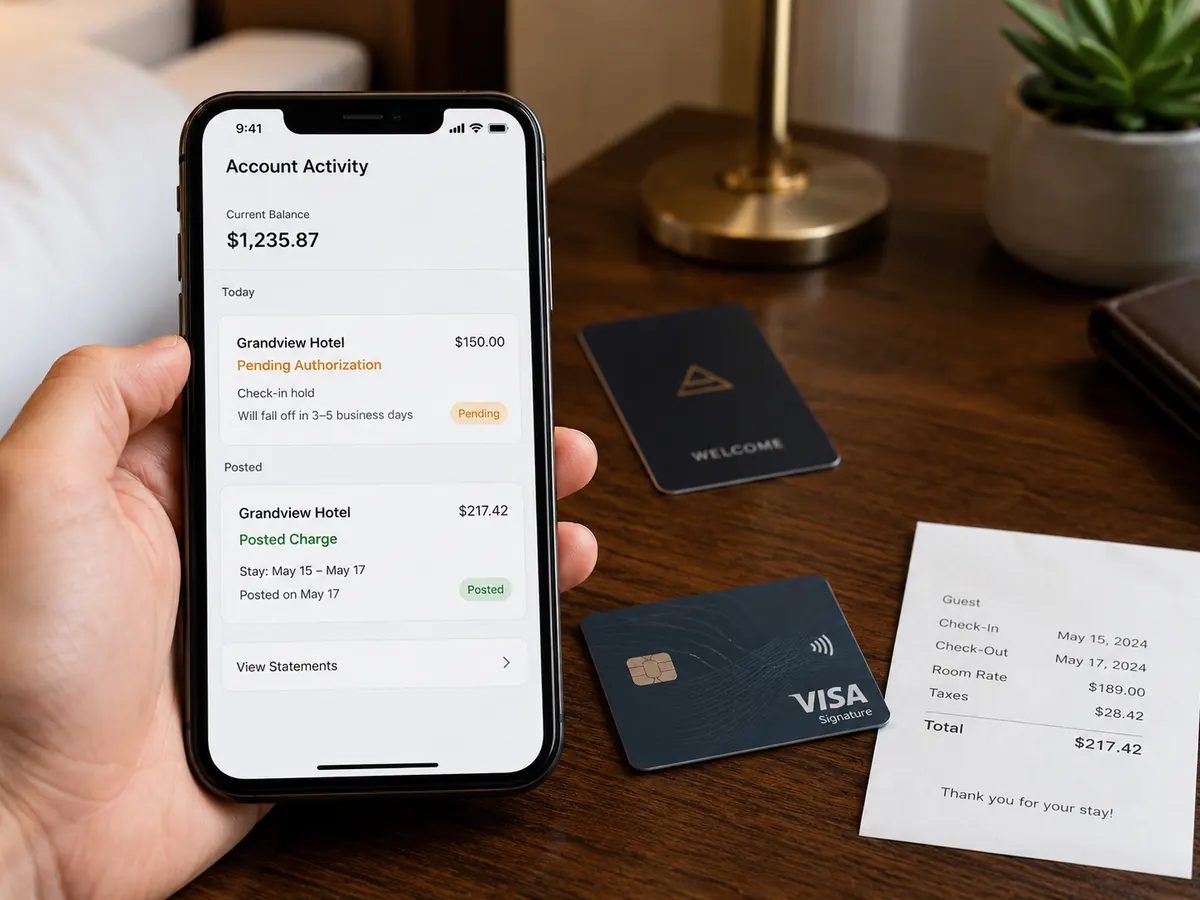
3. The Refund Waiting Game: Why Your Money Vanishes for 3–10 Business Days
Here’s the part that really messes with a travel budget: timing.
Most hotels say something like, We’ll release the hold at checkout.
That sounds instant. It usually isn’t.
What actually happens:
- The hotel releases the hold or processes a refund on their side.
- Your bank or card network then takes 3–10 business days (sometimes more) to reflect that change in your available balance.
So you check out on a Monday, but your money might not be fully usable until the following week or later. Meanwhile, you’re in another city, trying to pay for food, transport, and maybe another hotel that also wants a deposit. This is where the travel refund timeline becomes very real.
From what I’ve seen and what many hotels admit:
- Many properties release holds within 3–7 days.
- Some chains quote up to 10 business days, especially for incidentals.
- A small but painful percentage hold longer, especially if there are disputed charges or slow banks involved.
And remember: a refund and a released hold are not the same thing.
- A released hold just frees up your limit again. No money moves; the pending authorization expires.
- A refund is a real transaction that reverses a posted charge. That can take longer and may show as a separate line item.
When I’m planning a trip with multiple stops, I now assume:
- Money tied up in hotel #1 may still be unavailable when I arrive at hotel #2.
- Back-to-back stays can stack holds on top of each other.
To avoid getting squeezed mid-trip, I:
- Leave at least one full hotel’s worth of credit unused on my main travel card.
- Use a backup card or account for day-to-day spending.
- Ask at checkout:
Can you confirm the exact amount you’re releasing and the final amount you’re charging?
It’s not glamorous, but it keeps refund delays for cancelled trips and slow hotel releases from wrecking the rest of the journey.
4. Debit Cards, Tight Budgets, and the Risk of Getting Stranded
If you’re traveling on a tight budget or using a debit card, the stakes are higher. A hold isn’t just an accounting detail; it can be the difference between eating well and eating instant noodles.
Here’s why debit is so risky with hotel deposits:
- Holds can freeze real cash in your checking account.
- Some banks are slower to release debit holds than credit holds.
- If multiple hotels or car rentals stack holds, you can look “broke” to your own bank even when you’re not.
Imagine this scenario:
- You have $1,200 in your account.
- Hotel A holds $400.
- Hotel B (next city) holds $350.
- Your card now shows only ~$450 available, even though you haven’t actually spent that money yet.
Now add a delayed refund from a canceled tour or flight, and you’re suddenly in “card declined” territory while traveling. That’s how cash flow problems from delayed travel refunds and stacked holds can leave you stranded even when, on paper, you’re fine.
What I do now if I have to use debit:
- Call the hotel in advance and ask:
What’s the exact amount you’ll hold on a debit card, and for how long after checkout?
- Keep a separate debit account just for travel, with a buffer that I don’t plan to touch.
- Carry a low-limit credit card as a backup specifically for deposits and holds.
- If a property’s deposit policy sounds vague or changeable, I treat that as a red flag and look elsewhere.
When your budget is tight, the goal isn’t just to avoid fees. It’s to avoid having your own money locked away when you need it most.

5. Non-Refundable Rates and “Advanced Deposits”: The Illusion of Savings
Non-refundable rates look tempting. The price is lower, the terms are simple: Pay now, save money.
But there’s a hidden cost that doesn’t show up in the nightly rate: lost flexibility and frozen cash.
Some properties (often labeled as advance deposit
or advanced purchase
hotels) require:
- Full or partial payment upfront.
- Strict cancellation windows (24–72 hours or more).
- Non-refundable deposits for early or long-term bookings.
If your plans change, you might not just lose the room. You lose the cash, and you lose it right when you need it to rebook somewhere else. That’s the painful side of the prepaid vs pay at hotel comparison that doesn’t show in the headline price.
Here’s how I decide if a non-refundable rate is worth it:
- How much am I really saving? If it’s 5–10% and my plans aren’t rock solid, I usually skip it.
- What’s the cancellation window? If I can’t cancel within 48–72 hours without losing everything, I treat that as a gamble.
- What’s my backup plan? If a flight gets canceled or I get sick, can I afford to eat that deposit and still book another place?
Sometimes, paying a bit more for a flexible rate is actually a cash-flow decision, not just a comfort decision. You’re buying the right to keep your money mobile instead of locking it into one booking.
6. Stacking Holds: How Multi-Stop Trips Quietly Overload Your Cards
One hotel hold is annoying. Three or four in a row can quietly overload your cards.
Think about a typical multi-city trip:
- Hotel #1 places a hold when you check in.
- You check out, they release it, but your bank takes days to reflect it.
- Hotel #2 places a new hold while the first one is still “in limbo.”
- Hotel #3 does the same.
On paper, you might have plenty of credit or cash. In practice, your available balance shrinks with each stop, and you don’t see the full picture unless you track every hold and release. This is where managing travel budget with deposits becomes less about math and more about timing.
How I plan around this now:
- Map the holds when I plan the trip. I literally write down: city, hotel, estimated hold amount, and expected release window.
- Spread stays across cards if I’m doing multiple hotels in a short time.
- Use one card for hotels and another for flights, food, and daily spending so holds don’t choke everything at once.
- For long trips, I avoid back-to-back non-refundable deposits unless I have a serious cash buffer.
This sounds obsessive, but it’s the difference between Why is my card declining?
and Yes, I knew this would be tight, and I planned for it.

7. How to Take Control: A Simple Pre-Trip Cash-Flow Checklist
Most of the pain from holds and deposits comes from surprise. Once you know what to ask and what to track, the whole thing becomes manageable.
Here’s the checklist I use before I book and again before I fly. It’s my personal travel cost guide for holds and deposits in mini form.
Before you book
- Read the rate details and fine print on the hotel’s site or confirmation email.
- Look for words like “deposit,” “prepayment,” “non-refundable,” “security deposit,” “incidental hold.”
- If anything is vague, email or call and ask:
Is the deposit charged or just held?
Is it applied to my stay or refunded separately?
What’s the amount and when is it taken?
What’s the cancellation window to get it back?
Before you travel
- Estimate the total holds for all hotels and car rentals.
- Make sure your main travel card has enough unused limit to absorb those holds.
- Decide which card you’ll use for:
- Hotels and deposits.
- Daily spending.
- Emergency backup.
During and after your stay
- At check-in, confirm:
What total amount are you holding, and when will it be released?
- At checkout, ask for an itemized bill and verify the final charge vs. the original hold.
- If a hold hasn’t dropped off after 7–10 business days, contact both the hotel and your bank with dates and amounts.
None of this is glamorous. But it’s the kind of quiet planning that keeps your trip from being controlled by someone else’s payment system.
8. The Real Goal: Keep Your Money Mobile
Holds, deposits, and slow refunds aren’t going away. Hotels use them to protect against cancellations, damages, and unpaid bills. From their perspective, it makes sense.
From your perspective, the goal is different: keep your money mobile.
That means:
- Knowing exactly what kind of “deposit” you’re agreeing to.
- Using credit instead of debit when you can.
- Leaving room on your cards for stacked holds and slow refunds.
- Choosing flexibility over tiny discounts when your plans aren’t rock solid.
The next time a hotel says, We just need a deposit,
don’t nod and hand over your card. Ask what that really means for your cash flow. Your future self, standing at a foreign ATM with a “transaction declined” message, will be glad you did.