

I used to think airfare was mostly about timing and luck. Then I started reading the actual fare rules. That’s when I realised something important: airlines quietly punish short trips.
If you’ve ever searched a simple Monday–Wednesday return and wondered why it costs more than a longer holiday, you’ve probably run into minimum stay airfare rules – one of the industry’s favourite tools for squeezing business travellers.
In this guide, I’ll walk you through how those rules work, how they inflate your fare, and the specific tricks I use to dodge “business” pricing even when I’m travelling for work.
1. The Hidden Rule Behind Your Expensive Short Trip
Let’s start with the basic trap.
You search a quick out-and-back trip. Same route, same airline, same cabin. Then you shift your dates to include a Saturday night or add a couple of days… and suddenly the price drops by hundreds.
What changed? Not the distance. Not the fuel. The rules changed.
Most cheap fares come with conditions buried in the fare rules, like:
- Minimum stay: e.g.
3 days
orstay over a Saturday night
- Maximum stay: e.g.
30 days
or3 months
- Advance purchase: e.g.
must be booked 14 days before departure
Short trips – especially those without a Saturday night – are treated as business travel. The cheapest leisure fares are blocked, and you’re pushed into higher fare buckets with fewer restrictions and much higher prices. As this breakdown of airline minimum stay requirements shows, it’s deliberate segmentation, not random fluctuation.
The key idea: airlines don’t just sell seats; they sell rules. And those rules decide whether you pay a holiday price or a corporate price.
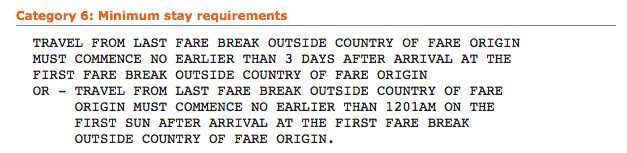
2. Why Airlines Love Minimum-Stay Rules (and How They Target You)
To understand how to beat this, it helps to think like the airline for a moment.
They know two things:
- Business travellers are less price-sensitive, travel on fixed dates, and often do short trips (Mon–Thu, no weekend).
- Leisure travellers are more flexible, stay longer, and chase deals.
So airlines use minimum-stay rules as a form of price discrimination and a quiet way to shape business travel flight pricing strategies:
- Attach strict rules (Saturday night stay, 3–7 day minimum) to the cheapest fares.
- Leave short, midweek trips to the expensive, flexible fares that businesses will pay for.
Combine that with dynamic pricing – where algorithms constantly adjust fares based on demand, day of week, and booking patterns – and you get the wild price swings you see in your search results.
Articles like this one on why the same flight costs more on different days and this deep dive into daily price changes all point to the same thing: the system is designed to charge you the maximum you’re likely to tolerate.
Minimum-stay rules are just one of the levers. But they’re one of the easiest for you to exploit once you know they exist.
3. How to Actually Read Fare Rules (Without Going Insane)
Most people never click the tiny fare rules
or ticket conditions
link on a booking page. I do. Every time. Because that’s where the game is explained.
Here’s how I skim fare rules without getting lost in jargon and airline pricing tricks for corporate travelers:
- Find the rules link
On most OTAs and airline sites, there’s a small link near the price:fare conditions
,rules
, orchange/cancellation policy
. Click it. - Look for these sections (wording varies, but the ideas are consistent):
- Minimum stay – phrases like
minimum stay 3 days
ormust stay over Saturday night
. This is where hidden rules that increase airfare usually live. - Maximum stay – e.g.
maximum stay 1 month
. - Advance purchase – e.g.
ticketing must be completed 14 days before departure
. - Penalties – change and cancellation fees.
- Minimum stay – phrases like
- Ignore the noise
You’ll see references to ATPCO categories, cryptic codes, and long legal paragraphs. I focus on anything that mentionsdays
,nights
,stay
, orreturn
.
Behind the scenes, systems like Travelport’s JSON Air APIs simply expose what airlines file via ATPCO: structured categories for minimum/maximum stay, advance purchase, and penalties, plus long text. If you’re curious, their Fare Rules Guide shows how granular this gets.
The practical takeaway: if you see a minimum stay in the rules, you know there’s a cheaper fare you’re currently locked out of. Your job is to change the trip so you qualify and avoid falling into common business traveler airfare traps.

4. Simple Date Tweaks That Turn a “Business” Fare into a “Leisure” Fare
This is where it gets interesting. Once I know a minimum stay is blocking me, I start playing with dates.
Think of it as timing flights to reduce ticket cost rather than just picking random dates and hoping for the best.
Move your return to unlock the cheap bucket
- Add a Saturday night: If your original plan is Mon–Fri, try Mon–Sat or Tue–Sun. Many airlines still use the classic
Saturday night stay
rule to separate business and leisure. The cost difference Saturday night stay flights can be huge. - Hit the minimum days: If the rule says
3-day minimum stay
, a Monday morning departure with a Wednesday evening return might be enough to drop you into a cheaper fare.
Use midweek patterns to your advantage
- Data from multiple sources shows Tuesday and Wednesday flights are often cheaper, while Friday and Sunday are usually more expensive due to demand from both business and leisure travellers. See, for example, this analysis of weekend vs weekday pricing.
- Try shifting your departure or return by just one day. I’ve seen $300+ drops on long-haul economy and even bigger swings in premium cabins.
Ask the uncomfortable question
Whenever I see a big price difference, I ask myself:
If I extend this trip by a day or two, does the saving on the ticket outweigh the extra hotel and food?
Sometimes the answer is yes, especially on long-haul or business-class tickets. You might literally be paid (in savings) to stay an extra night.
And if you’re travelling for work, this is where it gets tricky. Your company might prefer you to come back sooner, even if it costs more. But if you have flexibility – or you’re self-employed – it’s worth running the numbers and using these airfare hacks for business travelers to your advantage.

5. When You Can’t Stay Longer: Creative Workarounds
Sometimes you simply can’t add nights. Meetings are fixed. Family commitments are fixed. The minimum-stay rule still exists, but you can’t play along.
In those cases, I look at other levers to avoid business fare pricing without changing the length of the trip.
1. Split tickets and one-ways
Instead of a simple return, I’ll price:
- Two separate one-way tickets (possibly on different airlines).
- Open-jaw itineraries (fly into one city, out of another).
Sometimes the minimum-stay rule applies only to certain round-trip fare families, and one-ways give you more flexibility. The downside: if your first flight is delayed, the second airline has no obligation to help. I only do this when I’m comfortable with the risk or have long connections.
It’s also a good way to compare round trip vs one way business flight cost and see which structure the airline is quietly favouring.
2. Nearby airports and alternative routings
Dynamic pricing means some city pairs are heavily targeted for business travel. If I see brutal fares on a main route, I’ll check:
- Nearby airports (both at origin and destination).
- Different hubs or alliances.
Sometimes a short train or bus ride at one end can save hundreds and avoid the most aggressively priced business routes.
3. Mixed cabins and hidden premium deals
Here’s a counterintuitive one: sometimes premium cabins have leisure-style rules when they’re trying to fill seats. If I’m seeing eye-watering economy fares on a short business-heavy route, I’ll check:
- Premium economy or business with a Saturday night stay.
- Different date combinations in higher cabins.
Occasionally, a slightly longer stay in a premium cabin can cost the same as – or less than – a short, fully-flexible economy ticket. It’s one of those quiet minimum stay rule loopholes that only shows up if you’re willing to experiment.
4. Use tools that expose the pattern
I like using flexible-date search tools (like Google Flights’ calendar view) to see how prices move across a month. You’ll often see clear patterns:
- Spikes on Monday mornings and Friday evenings.
- Cheaper fares midweek and around Saturday nights.
Once you see the pattern, you can decide whether to bend your schedule or not. At least you’re making a conscious choice instead of being ambushed by the algorithm and falling into mistakes that raise business trip airfare.

6. The Other Rule You’re Probably Ignoring: Maximum Stay
Minimum stay gets most of the attention, but maximum stay rules matter too – especially if you like long trips or clever routings.
Airlines sometimes use maximum stays (e.g. 30 days) to stop people from exploiting cheaper fares that originate in other countries or regions. For example:
- A fare might be cheap if you start in Country A and fly to Country B, but only if you return within 30 days.
- If you try to stay 3 months, that cheap fare disappears and you’re pushed into a more expensive bucket.
This is another form of segmentation: shorter trips get one price, long stays get another. If you’re planning extended travel, always check the maximum stay in the rules before you build your itinerary around a great price.
And if you’re thinking of stringing together multiple cheap tickets from different origins, remember that each one has its own minimum and maximum stay rules. One broken condition can blow up the whole strategy.
7. If You Travel for Work: How to Play Within the Rules (and Still Save)
If you’re travelling on a company’s dime, you’re not just dealing with airline rules. You’re also dealing with policy.
Government contractors in the U.S., for example, have to follow strict rules under FAR 31.205-46 about what counts as reasonable travel cost, how per diems work, and when higher expenses are allowed. The details are dry, but the principle is simple: you’re expected to be cost-conscious, and you need justification for unusual choices. You can see how formalised this is in the regulation itself: FAR 31.205-46.
So how do you use minimum-stay tricks without breaking policy or getting flagged by your travel department?
- Document the savings: If staying an extra night unlocks a much cheaper fare, show the comparison. Some companies will approve the extra hotel if the total cost is lower.
- Know your per diem rules: If you’re on per diem, extra nights might not be allowed or might require special approval. Don’t assume.
- Use flexible dates within the same week: Even if you can’t add a weekend, shifting by a day or two can still move you out of the worst business peaks.
- Push back on default options: Corporate booking tools often surface the most convenient, not the cheapest, options. If you see a significantly cheaper alternative that still meets policy, flag it.
The mindset shift is this: you’re not just a passenger; you’re a buyer in a rigged market. The more you understand airline minimum stay requirements and the way they quietly shape airfare costs, the more intelligently you can push back.

8. A Simple Checklist Before You Book Your Next Flight
Before I hit purchase
on any ticket, I run through a quick mental checklist. It keeps me from sleepwalking into overpriced business fares.
- Did I read the fare rules? Specifically: minimum stay, maximum stay, and penalties.
- Did I try shifting dates? One or two days earlier/later, and at least one option with a Saturday night.
- Did I check nearby airports or different routings? Especially on business-heavy routes.
- Did I compare one-way vs return? Just to see if the structure changes the rules and the price.
- Am I okay with the change/cancel terms? Cheap fares often have brutal penalties.
Most people never do this. They accept the first price that fits their dates and assume it’s “the market”. It isn’t. It’s just the price the airline thinks you’ll tolerate, given the rules you’ve unknowingly agreed to.
If you start treating fare rules as part of the product – not fine print – you’ll see patterns you can exploit. You’ll know when a Saturday night is worth it, when a longer stay actually saves money, and when you’re being quietly nudged into a business fare you don’t really need.
And once you see it, you can’t unsee it. Which is exactly the point.