I’ve learned the hard way that the quickest way to wreck a trip (or a rideshare side hustle) is to assume, My car insurance will handle it.
On the road, assumptions are expensive. Rental cars and rideshare trips seem simple, but the insurance behind them is anything but.
This guide walks through the real differences between your personal auto policy, rental car coverage, and rideshare insurance. The goal is simple: help you spot the gaps before you’re staring at a bill for thousands because of a line of fine print you never knew existed.
1. First Question: Does Your Own Auto Policy Actually Follow You?
Before you worry about rental counters or rideshare apps, start with what you already have. Most people never read their policy. They just know what hits their bank account every month.
Here’s the core idea: your personal auto insurance usually follows you, not just your car – but only in certain situations.
- Rental cars for personal use: In the U.S., most standard policies extend your liability, and often your collision and comprehensive, to a rental car used for personal travel. The rental is treated like your own car, with the same limits and deductibles you already carry (source, source). This is where a lot of people assume their personal car insurance and rental coverage are identical – they’re not.
- Rideshare driving: The moment you turn your car into a money-maker (Uber, Lyft, delivery), insurers see it as commercial use. Your personal policy usually stops covering you while you’re working (source). That’s where personal auto insurance rideshare coverage or endorsements come in.
- International trips: U.S. auto policies generally do not cover you abroad, especially in places like Mexico. You often need country-specific insurance (source).
The trap? Someone says, You’re covered,
and the questions stop there. But the real questions are:
- Covered for what exactly?
- With which deductibles and which exclusions?
- Does that coverage apply when you’re working or out of the country?
If you can’t answer those in one sentence, you don’t really know your coverage yet.
2. Renting a Car: What Your Policy Covers vs. What the Counter Tries to Sell You
You’re at the rental counter, jet-lagged, just wanting the keys. Someone rattles off insurance options at auction speed. This is where people either overpay or walk away with big rental car insurance coverage gaps.
Here’s what usually happens when you rent a car for personal use in the U.S.
- Liability coverage: Your own liability almost always follows you to a rental. If you injure someone or damage their property, your policy’s liability limits typically apply. The rental company’s extra liability is often redundant unless your limits are low and you want more protection.
- Collision & comprehensive: If you carry these on your own car, they usually cover damage or theft of the rental. If you don’t, you may have no coverage for the rental car itself. That’s when the rental’s Collision Damage Waiver (CDW/LDW) becomes important. This is the heart of the rental car collision damage waiver explained in plain terms: it shifts the risk for damage to the rental company (with plenty of fine print).
- Deductibles & fees: Even if your policy covers the damage, you still pay your deductible. And your insurer may not cover loss-of-use fees, diminished value, or administrative fees the rental company tacks on (source, source).
So when does it actually make sense to buy the rental company’s coverage?
- You don’t have collision/comprehensive on your own policy.
- You want to avoid using your own insurance (and risking a rate hike) for a minor accident.
- You’re okay paying a bit more per day to avoid a big deductible and annoying fee disputes later.
My rule of thumb: I ask myself, If this car got totaled tomorrow, how much cash would I be willing to write a check for?
If that number is lower than my deductible plus potential fees, I seriously consider the CDW or a third-party policy. That’s the real-world version of comparing primary vs secondary rental car insurance and deciding how much risk you want to keep.
3. The Hidden Gaps: What Rental Car Insurance Usually Doesn’t Cover
Even when you think you’re covered in a rental, there are quiet gaps that can sting later. This is where a lot of rental car insurance mistakes to avoid show up.
- Personal belongings: Your auto policy typically does not cover your laptop, camera, or luggage if they’re stolen from the rental. That’s usually a job for your renters or homeowners insurance, or a specific Personal Effects Coverage add-on (source).
- Injuries to you and your passengers: If your policy includes PIP (Personal Injury Protection) or MedPay, that may already cover medical bills, regardless of fault. The rental company’s Personal Accident Insurance often duplicates this.
- Exotic or luxury cars: Many personal policies only extend to rentals of
similar value
to your own car. That dream weekend in a high-end convertible might not be covered at all (source). - Business use: Using a rental for business can change how coverage applies. Some policies allow it, some don’t. If you’re mixing business and personal, ask your insurer directly.
The uncomfortable truth: you can be technically insured and still owe thousands because of deductibles, exclusions, and fees. That’s why I always check three things before I decline coverage:
- My deductible for collision/comprehensive.
- Whether my policy covers loss of use and diminished value.
- Whether my credit card adds any rental protection on top.
That last one matters more than most people realize, especially if you’re relying on credit card rental car insurance coverage to fill the gaps.
4. Credit Cards & Third-Party Policies: Smart Backup or False Sense of Security?
A lot of travelers think, My travel card covers rentals, so I’m good.
Sometimes that’s true. Sometimes it’s wishful thinking.
Here’s how credit card coverage usually works:
- You must pay for the rental with that card.
- You must often decline the rental company’s CDW.
- Coverage usually applies to damage or theft of the rental car, not liability to others (source).
- Most cards offer secondary coverage, meaning your personal auto insurance pays first; the card fills some gaps.
- Some premium cards (like certain Chase Sapphire or Capital One cards) offer primary coverage, letting you avoid involving your personal insurer at all.
Then there are standalone rental car insurance products (Allianz, Bonzah, Sure, etc.). These can provide primary coverage for damage/theft, often in the $35,000–$100,000 range, for roughly $11–$22+ per day, sometimes with extras like trip interruption and roadside assistance (source, source).
When do these make sense?
- You have a high deductible and don’t want to risk using your own policy.
- You’re renting abroad and want a clear, written policy in your language.
- You don’t own a car (and have no auto policy) but still want strong protection.
They’re useful, but they’re not magic. There are still exclusions: off-road use, certain countries, certain vehicle types. Think of them as one more tool in your travel insurance for rental cars and rideshares toolkit, not a blanket guarantee.
5. Rideshare as a Passenger: Are You Covered in That Uber or Lyft?
Now flip roles. You’re not driving. You’re in the back seat of a rideshare, scrolling your phone. If there’s a crash, who actually pays?
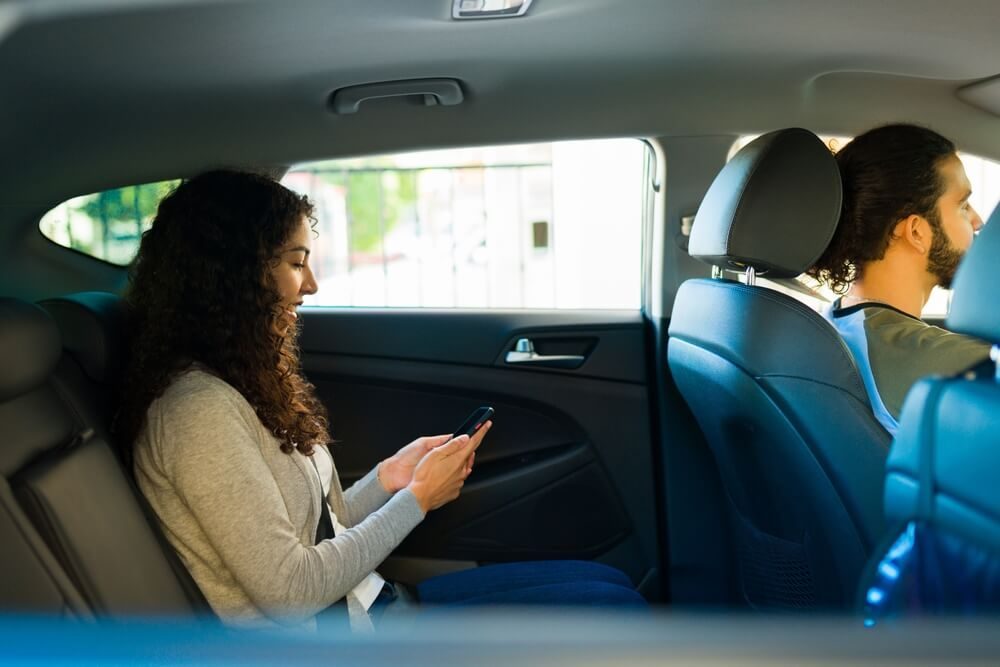
Rideshare companies like Uber and Lyft are required to carry insurance, but it’s layered and depends on what the driver is doing at the time. This is where people start asking, In a rideshare accident, who pays?
- App off: The driver’s personal auto insurance is in play. The rideshare company’s policy is not.
- App on, waiting for a ride (Period 1): The company usually provides limited liability coverage, but collision coverage can be thin or absent. This is a gray zone for drivers (source).
- En route to pick up / with passenger (Periods 2 & 3): This is where the big commercial policy kicks in. Uber and Lyft typically provide up to $1 million in liability coverage plus some coverage for the driver’s car (with a high deductible).
As a passenger, you’re usually in the best-protected window (Periods 2 & 3). If you’re injured, there’s typically a large liability policy available. But:
- Claims can still be slow and messy, especially if another driver is at fault.
- Your own health insurance and possibly your own auto policy’s MedPay/PIP may still come into play.
- Outside the U.S., rules and limits can be very different. Don’t assume the same $1M structure applies everywhere (source).
From a passenger’s perspective, insurance for Uber and Lyft passengers is usually decent, but not instant or painless. I assume I’ll rely first on my health insurance and only then on whatever liability coverage the rideshare company has. That mindset keeps me from overestimating how protected
I really am.
6. Rideshare as a Driver: The Biggest Insurance Gap Most People Ignore
If you’re driving for Uber, Lyft, or delivery apps, the insurance story changes completely. This is where people get blindsided by hidden gaps in rideshare insurance policies.
Here’s the uncomfortable reality:
- Your personal auto policy is not designed for commercial use. If you crash while logged into a rideshare app, your insurer can deny the claim or even cancel your policy (source, source).
- Uber and Lyft provide coverage only when the app is on, and the level of coverage changes by period:
- Period 0 – App off: Only your personal policy applies. No rideshare coverage.
- Period 1 – App on, waiting for a request: Limited liability from the rideshare company, often no collision for your car. This is the notorious gap.
- Periods 2 & 3 – En route / passenger in car: Higher liability limits and collision coverage, but with very high deductibles (often $1,000–$2,500).
That’s why rideshare endorsements and rideshare-specific policies exist. They’re designed to:
- Extend your personal coverage into rideshare use.
- Fill the Period 1 gap (when you’re waiting for a ride).
- Sometimes reduce or replace the huge deductibles on Uber/Lyft’s policies (source).
- Keep your insurer from dropping you for undisclosed commercial activity.
If you’re doing food delivery only (Uber Eats, DoorDash, Instacart, Amazon Flex), don’t assume you’re safe. Many insurers treat that as commercial use too, and you may need a delivery-specific endorsement.
My personal rule: If an app is paying you to move people or stuff, you need to talk to your insurer. If you don’t, you’re gambling with your car, your savings, and your liability. And if something goes wrong, questions about rideshare liability coverage limits will suddenly feel very real.
7. Rental Car vs. Rideshare on a Trip: Which Is Safer Financially?
When I plan a trip, I don’t just ask, What’s cheaper?
I ask, What’s cheaper if something goes wrong?
That’s the real rental car vs rideshare insurance question.
Here’s how I compare renting a car vs. relying on rideshares, from an insurance and risk perspective.
When a rental car makes more sense
- You’ll be making frequent daily stops (sightseeing, errands, remote areas). Rideshares can add up fast.
- You’re comfortable driving locally and want control over your schedule.
- You’re willing to manage insurance proactively: checking your policy, maybe adding a third-party CDW, and documenting the car’s condition.
Financially, a rental can be safer if you:
- Know your deductibles and limits.
- Use a card with strong rental coverage.
- Consider a third-party policy to cap your risk (source).
When you understand how your personal car insurance and rental coverage work together, you can decide whether to lean on your own policy, your card’s protection, or a separate plan.
When rideshare makes more sense
- You’re in a city with good rideshare availability and/or strong public transit.
- You’ll only take a few trips a day (airport, hotel, dinner, maybe one attraction).
- You don’t want to deal with parking, fuel, or rental counter upsells.
From an insurance angle, rideshare can be simpler for you as a passenger: you’re not responsible for the car, and there’s usually a large liability policy in the background. But you’re also trusting:
- The driver’s judgment.
- The rideshare company’s claims process.
- Local laws and coverage limits, which may be weaker than you expect abroad.
So I ask myself:
- How often will I be in a car? Few rides usually point to rideshare; lots of driving often favors a rental.
- How comfortable am I driving here? If the answer is not very, rideshare wins.
- How much hassle am I willing to accept up front to reduce risk later? More prep usually means a rental with carefully chosen coverage.
There’s no universal winner. It’s about which risks you’re willing to carry and how you want to handle them.
8. A Simple Checklist: How to Plug Your Biggest Road-Trip Insurance Gaps
If you’ve read this far, you already care more than the average traveler. Let’s turn that into a quick checklist you can actually use to avoid nasty surprises with both rental cars and rideshares.
Before renting a car
- Call or log into your insurer and confirm:
- Do my liability, collision, and comprehensive extend to rental cars?
- What are my deductibles?
- Any exclusions for luxury/exotic or international rentals?
- Check your main credit card’s rental benefits:
- Is it primary or secondary rental car insurance?
- What are the coverage limits and excluded countries/vehicles?
- Decide in advance: If the rental is totaled, what’s the maximum you’re willing to pay out of pocket? Choose CDW/third-party coverage accordingly.
Before driving for rideshare or delivery
- Tell your insurer you plan to drive for Uber/Lyft or delivery apps.
- Ask specifically about a rideshare endorsement or rideshare-friendly policy in your state (source).
- Confirm in writing:
- What’s covered when the app is off, on but waiting, and on with a trip?
- What deductibles apply in each period?
- Track your premiums and mileage; some costs may be tax-deductible as a business expense.
Before relying heavily on rideshares as a traveler
- Check rideshare availability and safety reputation at your destination.
- Make sure your health insurance works there (especially abroad).
- Have a backup plan: local taxis, public transit, or a rental if rideshares are scarce or unreliable.
In the end, the goal isn’t to buy every possible policy. It’s to know, in advance, who pays when something goes wrong. Once you’re clear on that, you can choose between rental cars and rideshares with your eyes open – and keep your trip, and your bank account, intact.