

I used to treat layovers as dead time. Now I treat them as bonus cities. The difference isn’t luck. It’s planning.
If you’re willing to think a bit like a travel hacker and a bit like a project manager, you can turn that 8–20 hour connection into a mini stopover that actually feels like a trip. The trick is knowing when it’s worth leaving the airport, when it’s smarter to stay put, and how to design a layover that doesn’t end with you sprinting to the gate.
1. Is This Layover Even “Explorable”?
Before you start daydreaming about canals in Amsterdam or hawker food in Singapore, ask one blunt question: Is this layover realistically explorable, or am I about to stress myself out for 90 rushed minutes in the city?
Here’s the framework I use for smart layover planning when I’m deciding whether to turn a connection into a mini trip.
- Under 6 hours (international): I stay airside. Lounge, nap pod, long walk around the terminal – leaving the airport is almost never worth it.
- 6–8 hours: Borderline. I’ll only leave if immigration is usually fast, the airport–city link is quick (ideally an express train), and I already know the city.
- 8–10 hours: This is the sweet spot for a mini city break in a transit-friendly hub.
- 10–24 hours: Now we’re in deliberate stopover territory. I plan a proper half-day or overnight.
Those numbers don’t mean much until you translate them into actual exploration time. I literally do this math on a notepad:
- Deplaning + immigration: 45–90 minutes (more if arrival is peak time).
- Airport → city (one way): 20–60 minutes.
- City → airport (one way): 20–60 minutes.
- Security + getting to gate on return: 60–90 minutes.
- Buffer for delays and “stuff happens”: at least 60 minutes.
Whatever is left is your real time in the city. If that number is under 2 hours, I usually don’t bother. If it’s 3–6 hours, I plan a tight, high-impact route: one neighborhood, one view, one meal.
Some airports make this easy. Amsterdam, Singapore, Seoul, Zurich, Lisbon, Dubai, Toronto – they all have fast airport–city links and compact areas you can enjoy in a short window. Others are a traffic nightmare. I’m looking at you, airports where the “city” is 90 minutes away in rush hour.
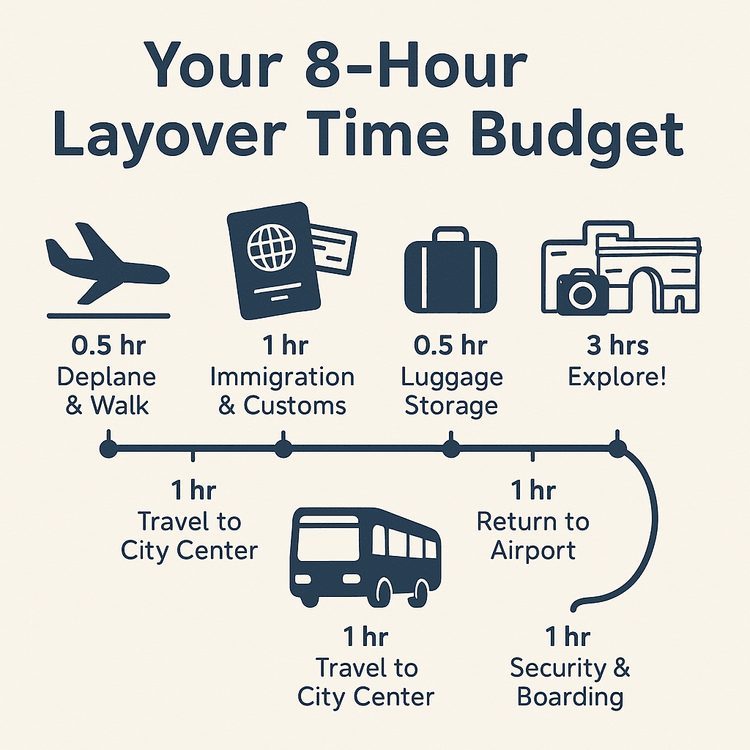
Takeaway: Don’t decide based on the layover number on your ticket. Decide based on the usable hours after you subtract all the friction.
2. Can You Legally Leave the Airport?
This is the unsexy part that ruins more layover dreams than bad weather: visa and entry rules.
Before I book anything, I ask myself:
Does my passport allow me to enter this country visa-free or with visa-on-arrival?
Is there a special transit visa I need, and can I actually get it in time?
Are there weird rules about leaving the airport on a transit ticket?
Transit rules are not intuitive. Some countries let you breeze through immigration for a few hours with no visa. Others will happily let you sit airside for 20 hours but won’t let you step outside without a pre-arranged visa.
I never rely on random forum posts for this. I go straight to:
- The official immigration or foreign ministry website.
- The airline’s transit information page.
- Tools like IATA’s Timatic (often embedded in airline sites when you check in).
And I assume rules can change. If I’m planning a big layover months ahead, I re-check closer to departure.

One more thing people forget: re-entry. If your layover is in your home country on the way back, you’re doing full immigration and customs, then security again. That eats time. If it’s in a country you’ve just left (like a Schengen hub after a Europe trip), you might be exiting a zone, not entering – different lines, different timing.
Takeaway: If you can’t clearly answer Yes, I’m allowed to enter and exit this country on this passport and ticket
, you don’t plan a city excursion. You plan a great airport day instead.
3. Are You Booking the Right Kind of Layover or Stopover?
Most people let the airline decide their layover. I prefer to design mine and turn layovers into mini trips on purpose.
First, I separate two concepts:
- Layover: Under 24 hours on an international ticket. Usually just a connection.
- Stopover: 24+ hours in a connecting city. This is basically an extra destination.
Airlines and booking engines treat these differently, and that’s where the opportunity is if you’re comparing layover vs stopover flights.
Use airline stopover programs when they’re generous
Some airlines actively want you to stay in their hub and will reward you for it:
- Icelandair: Free stopovers in Reykjavik for up to 7 days on transatlantic routes, often with no extra airfare.
- Turkish Airlines: Free hotel nights in Istanbul for long layovers on eligible tickets, plus city tours in some cases.
- Qatar Airways, Emirates, Singapore Airlines, TAP Air Portugal: Various stopover deals, discounted hotels, or city tours.
The catch? Hotel locations might be inconvenient, and the “free” part sometimes comes with conditions. I always check:
- Is the hotel actually near where I want to be?
- What’s included (breakfast, transfers, taxes)?
- Do I lose flexibility by booking this fare type?
Build your own stopover with multi-city searches
When there’s no official program, I use the Multi-city option on tools like Google Flights or Kayak. I’ll try something like:
- Leg 1: Home → Hub City (date 1)
- Leg 2: Hub City → Final Destination (date 2 or 3)
- Leg 3: Final Destination → Home (direct or via another hub)
Weirdly, adding a stop can sometimes make the whole ticket cheaper because of airline pricing quirks. It’s one of my favorite tricks for budget travel with intentional layovers.
When I’m doing this, I also:
- Use the “bags” filter to avoid basic economy fares that don’t include a carry-on.
- Mix a legacy carrier for the long-haul with a budget airline (Ryanair, EasyJet, Vueling) for short hops.
- Pay for priority boarding and a carry-on on budget airlines – still cheaper, but far less painful.

Takeaway: Don’t just accept whatever 90-minute connection the search engine throws at you. Use stopover programs or multi-city searches to intentionally build in a mini trip – often for the same price, especially when you’re hunting for connecting flights with free stopovers or low-cost add-ons.
4. How Will You Move Fast and Stay Connected?
A layover city dash is basically a race against the clock. Two things make or break it: transport and connectivity.
Transport: trains beat taxis (most of the time)
When I’m planning a sightseeing layover, I look up the airport–city options before I even book the flight:
- Express trains / metros: Usually the fastest and most predictable. Think Amsterdam, Zurich, Seoul, Singapore, Lisbon.
- Airport buses: Fine if they have dedicated lanes or frequent service.
- Taxis / ride-hailing: Great off-peak, risky in rush hour. I avoid them if traffic is notorious.
If there’s an airport express train, I almost always choose it. I’ll often buy a round-trip ticket as soon as I land so I don’t waste time figuring it out later.
Connectivity: don’t waste 45 minutes hunting a SIM
On a normal trip, spending half an hour buying a local SIM is annoying but survivable. On a 6-hour layover, it’s a disaster.
This is where eSIMs are genuinely useful. I’ll check if my phone supports eSIM, then buy a short-term data plan (for example, via providers like Yoho Mobile) before I fly. I activate it on landing and I’m instantly online for:
- Maps and transit apps.
- Ride-hailing and taxis.
- Translation tools.
- Mobile payments or OTPs from my bank.
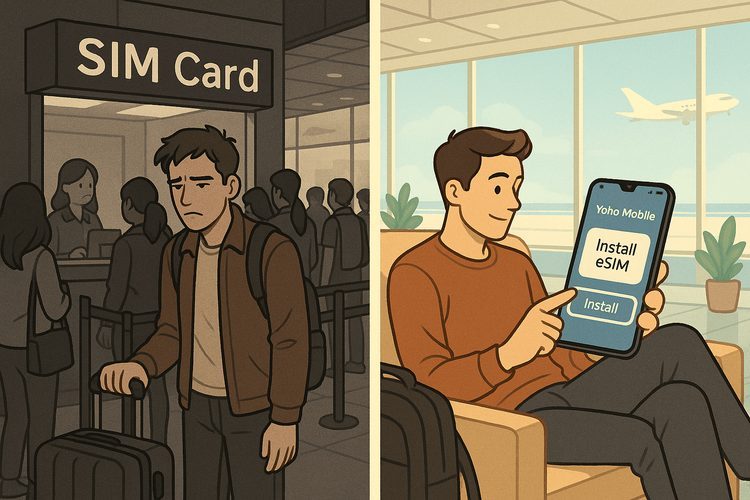
That means I can walk straight past the SIM card kiosks and head for immigration or the train. On a tight layover, that’s real time saved.
Takeaway: Decide your airport–city transport and your connectivity plan before you land. If you’re figuring both out in the arrivals hall, you’re already behind schedule.
5. What Do You Do With Your Stuff?
Dragging a roller bag over cobblestones or through metro turnstiles for a 3-hour city sprint is a special kind of misery. I try to avoid it at all costs.
Here’s how I think about luggage on layovers:
- Checked bags through to final destination: Ideal. I only have my carry-on to worry about.
- Carry-on only: I still don’t want to lug it around. I look for airport luggage storage or lockers.
- Forced baggage claim: Some itineraries make you collect and re-check bags. In that case, I factor in extra time and still try to store them at the airport.
Most big hubs have left-luggage services or lockers in the arrivals hall or near train stations. I check:
- Opening hours (24/7 or not).
- Maximum storage time.
- Security and whether they scan bags.
- Payment method (card vs cash).
Once my main bag is stored, I switch to a tiny day kit:
- Passport and boarding pass (digital + paper backup).
- Wallet and one card that works internationally.
- Phone + power bank + cable.
- Water, light snack, maybe a packable jacket.
I keep this in a small foldable backpack or tote that lives in my main carry-on. It sounds fussy, but it’s the difference between feeling like a commuter and feeling like a traveler.
Takeaway: If you can’t store your main bag easily and safely, your “mini city stopover” will feel like a forced march. Solve luggage first, sightseeing second.
6. What’s the One Thing You Want From This Layover?
The biggest mistake I see (and have made) is trying to do too much. A layover is not a full city break. It’s a sampler.
So I ask myself one simple question: If everything runs late and I only get one thing, what do I want it to be?
Then I build the layover around that. It keeps my layover itinerary planning tight and realistic.
- One view: A rooftop, a waterfront, a skyline walk.
- One neighborhood: Canals in Amsterdam, a market in Istanbul, a historic core in Lisbon.
- One meal: A hawker center in Singapore, a tapas bar in Madrid, a café in Paris.
I keep the plan brutally simple:
- Airport → city via the fastest route.
- Walk a tight loop that hits my “one thing” plus maybe one or two extras nearby.
- Meal or coffee built into that loop.
- Back to the airport with a minimum 3-hour buffer before boarding.

If I’m exhausted or jet-lagged, I flip the script. Instead of forcing myself into the city, I might book an in-terminal micro-hotel (YOTEL, Minute Suites), grab a shower, sleep for 3 hours, and have a slow meal. That can be a better “mini vacation” than a frantic sightseeing dash.
Takeaway: A smart layover is about one clear win, not a checklist. Decide your win, design around it, and be willing to downgrade to “rest and reset” if your body says so.
7. When Is It Smarter to Stay in the Airport?
Sometimes the bravest decision is to admit that leaving the airport is a bad idea.
I stay airside when:
- The layover is under 6–7 hours and immigration is slow.
- Visa rules are unclear or restrictive.
- It’s the last flight of the day to my final destination.
- I’m arriving at night in a city I don’t know well.
- I’m already wrecked from previous flights.
But staying in the airport doesn’t have to mean suffering in a plastic chair.
- Lounges: I use Priority Pass, credit card perks, or day passes for food, showers, and quiet.
- Micro-hotels: Hourly rooms inside security for real sleep and a shower.
- Progressive meals: Appetizer in one place, main in another, dessert somewhere else – it turns airport food into a mini tasting tour.
- Airport “sightseeing”: Art exhibits, meditation rooms, gardens (Changi, I’m looking at you), even small museums in some hubs.

Takeaway: A smart layover isn’t always about leaving the airport. It’s about using that time intentionally – whether that’s a quick city hit, a proper nap, or a quiet few hours to reset before the next leg.
Putting It All Together: Your Mini Stopover Checklist
When I’m turning a connection into a mini city stopover, I run through this quick checklist. It keeps me honest and helps avoid the classic mistakes to avoid with long layovers:
- 1. Time: Do I have at least 8–10 hours, and what’s my real city time after all the subtractions?
- 2. Legal: Am I 100% sure I can enter and exit this country on my passport and ticket? Have I checked the latest international layover immigration rules?
- 3. Design: Can I tweak my flights or use a stopover program to make this layover longer and more useful?
- 4. Transport: What’s the fastest, most reliable airport–city–airport route, and how long does it take?
- 5. Luggage: Where will my big bag be, and what’s in my small day kit?
- 6. Connectivity: Is my eSIM or data plan ready so I’m online the moment I land?
- 7. Focus: What’s the one thing I want from this layover – a view, a meal, a neighborhood, or just real rest?
If I can’t answer those questions confidently, I don’t force it. But when everything lines up – especially on long or overnight layovers – that “annoying” connection becomes the highlight of the trip: a stolen afternoon in a new city, paid for by a flight I had to take anyway.
Next time you see a long layover in your search results, don’t just groan. Ask yourself: Could this be my next mini stopover?